Most Florida homeowners assume squirrel activity peaks in fall, but the reality is that squirrels are a year-round nuisance in Central Florida — and twice a year they become significantly more problematic. Florida’s squirrel species breed on a schedule that directly increases the risk of attic intrusions, and understanding that schedule is one of the most practical things a homeowner can do to stay ahead of the problem. Here’s what you need to know about squirrel breeding season in Florida and what it means for your home.
Which Squirrel Species Live in Florida?
Florida is home to several native squirrel species, but three are most relevant to homeowners dealing with nuisance wildlife:
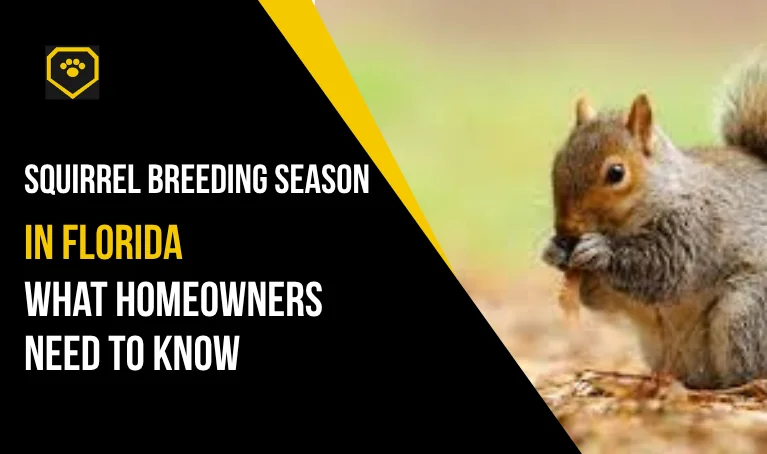
- Eastern Gray Squirrel (Sciurus carolinensis) — The most common squirrel throughout Central Florida. This is the species responsible for the majority of attic intrusions and structure damage in residential areas. Highly adaptable, bold, and capable of fitting through openings as small as 1.5 inches.
- Southern Flying Squirrel (Glaucomys volans) — Smaller and nocturnal, flying squirrels are frequently overlooked because they are active at night. Colonies of 10 to 20 individuals can occupy an attic for months before a homeowner detects them. They are also common in Central Florida but far less visible than gray squirrels.
- Fox Squirrel (Sciurus niger) — Larger than the gray squirrel and less commonly found in residential areas. Two subspecies are worth noting: the Big Cypress fox squirrel and Sherman’s fox squirrel, both of which are listed as threatened under Florida law and cannot be trapped, harassed, or harmed.
For most homeowners, the Eastern gray squirrel and the Southern flying squirrel are the primary concern.
When Is Squirrel Breeding Season in Florida?
Eastern gray squirrels in Florida breed twice per year. The first breeding season runs from December through February, with peak activity in January. The second breeding season runs from May through July, with peak activity in June. After a gestation period of approximately 44 days, litters of two to four young are born — meaning birth peaks fall in February through March for the winter cycle, and July through August for the summer cycle.
Southern flying squirrels have a similar two-cycle pattern: their first breeding season runs January through March, with births in February and March. The second cycle runs July through September, with births in August and September.
These overlapping cycles mean that for Florida homeowners, there are essentially two windows of elevated intrusion risk per year rather than one. Squirrels entering attics to nest are not random — they are following a reproductive drive that makes finding a warm, protected, elevated structure a priority.
Also Read: Squirrel Droppings Identification Guide
Why Squirrels Enter Attics During Breeding Season
Female squirrels are the primary drivers of attic intrusions during breeding season. A pregnant female seeks a nesting site that is elevated, protected from predators, thermally stable, and close to a reliable food source. Florida attics check every one of these boxes. The animal doesn’t need a large opening — gray squirrels can enter through gaps as small as 1.5 inches, and flying squirrels can squeeze through openings barely an inch in diameter.
Common entry points include:
- Roof vents with damaged or absent screens
- Gaps between the roofline and fascia board
- Loose or missing soffit panels
- Utility and pipe penetrations through the roofline
- Gaps around dormers or where different roof pitches meet
- Chewed-out openings created by previous squirrel occupants
Once a female establishes a nest in an attic and successfully raises a litter, the risk of repeated entry increases sharply. The offspring of that litter, once mature, are biologically inclined to return to familiar nesting sites — including the attic where they were born. A single unaddressed entry point can result in a multi-year, multi-generation squirrel problem.
What Damage Do Squirrels Cause in Florida Attics?
Squirrels cause several categories of damage that become more extensive the longer they go unaddressed:
- Insulation damage: Squirrels tear up blown-in or batt insulation to build nests and establish latrine areas. Contaminated insulation typically must be removed and replaced entirely, which is a significant expense.
- Electrical wire damage: Squirrels chew on electrical wiring as part of their natural gnawing behavior. Exposed wires in attics represent a serious fire hazard. The National Fire Protection Association has identified rodent-chewed wiring as a documented cause of residential house fires.
- Wood and structural damage: Squirrels chew through wood framing around entry points, expanding access holes over time and creating water infiltration points. They also chew on roof decking and wooden structural members inside the attic.
- Water damage: Enlarged entry points created by squirrel chewing allow water intrusion during Florida’s rain season, which can lead to mold growth and secondary structural damage.
- Noise and contamination: Squirrel urine and feces accumulate in concentrated areas within the attic. Beyond the odor, dried squirrel feces can harbor pathogens, and the smell of urine acts as an attractant for other squirrels.
Must Read: Squirrel Sounds Identification Guide
How to Tell If Squirrels Are Breeding in Your Attic
The clearest signs of squirrel breeding activity in a Florida attic include:
- Daytime sounds: Gray squirrels are diurnal — active during daylight hours. Scratching, rolling, and scurrying sounds in the attic during morning and late afternoon are highly characteristic of gray squirrel activity.
- Nighttime sounds: Flying squirrels are nocturnal. Light, rapid scurrying sounds in the attic after dark are the primary indicator of a flying squirrel colony.
- Visible entry damage: Chewed or enlarged openings around roof vents, soffit corners, or fascia board gaps. Fresh chew marks appear lighter in color than the surrounding wood.
- Squirrel sightings on the roofline: If you observe gray squirrels on your roof — particularly if the same animal returns to the same location repeatedly — it is almost certainly using an entry point on the roofline.
- Insulation disturbance visible from the attic hatch: If you can safely open and illuminate your attic hatch, disturbed insulation, nest material (leaves, Spanish moss, insulation fibers), and droppings confirm squirrel presence.
Helpful for you: Squirrel Tracks Identification Guide
How to Keep Squirrels Out of Your Attic During Breeding Season
1. Inspect Your Roofline Before Each Breeding Season
Conduct a visual inspection of your roofline before the start of each breeding cycle — ideally in November (before the winter cycle) and in April (before the summer cycle). Look for gaps, damaged screens on vents, and chewed or deteriorated wood around the roofline. Binoculars make it easier to inspect the upper roofline from the ground without ladder access.
2. Screen and Seal All Roof Vents
Roof vents and gable vents are the most common entry points for squirrels in Florida homes. Install hardware cloth (½-inch galvanized mesh) over all existing vents, ensuring the mesh is secured with screws, not staples. Squirrels will remove stapled mesh in minutes. Commercial vent covers with metal mesh are also available and preferable to plastic covers, which squirrels chew through easily.
3. Trim All Overhanging Tree Limbs
Squirrels use tree branches that extend over or near the roofline as direct access ramps to your roof. Trim any branches that come within six to eight feet of the roofline. While squirrels can jump farther than this, reducing the number of easy access points meaningfully reduces activity on the roof.
Also Read: Most Common Pests in Florida
4. Install Squirrel Baffles on Trees Near the House
Metal squirrel baffles installed around tree trunks within 10 to 12 feet of the house prevent squirrels from climbing those trees to reach the roof. Baffles must be installed at least five feet above ground level and should be smooth metal — aluminum sheet metal wrapped around the trunk is effective and low-cost.
5. Seal All Gaps in the Fascia and Soffit
Walk the perimeter of your home with a flashlight and inspect the fascia and soffit junction for gaps. This is particularly important in older Florida homes where wood fascia has deteriorated. Use galvanized hardware cloth, aluminum flashing, or foam backer rod plus exterior caulk to close small gaps. Do not use foam alone — squirrels chew through it.
6. Do Not Seal Entry Points While Squirrels Are Inside
One of the most common and costly mistakes homeowners make is sealing entry points while squirrels are still inside the attic. A squirrel trapped inside will cause extensive damage trying to escape, and young that cannot exit will die inside the attic. If you have confirmed squirrel activity, have a professional wildlife trapper remove or exclude the animals first, then complete the sealing work.
7. Use One-Way Exclusion Devices for Active Entry Points
Licensed nuisance wildlife trappers use one-way exclusion devices installed over active entry points to allow squirrels to exit but not re-enter. This is the preferred method when squirrels are present but kits are not yet confirmed — it removes the animals humanely without trapping. After squirrels have exited, the exclusion device is replaced with a permanent seal.
8. Call a Professional If Kits Are Present
If breeding season is underway and you hear the distinctive high-pitched chittering sounds of squirrel kits in your attic, exclusion devices are not appropriate — kits cannot exit on their own and will die. In this situation, a licensed wildlife trapper must enter the attic, locate the nest, and manually remove the kits along with trapping the mother. Do not attempt this yourself; young squirrels bite defensively, and rabies, while rare in squirrels, is a consideration.
Helpful for you: Summer Wildlife Activity in Central Florida
Florida Law on Squirrel Trapping and Removal
Eastern gray squirrels and Southern flying squirrels are classified as game animals under Florida law (Chapter 379, Florida Statutes). Under FWC rules, homeowners may trap nuisance squirrels on their own property, but trapped squirrels must be released on-site or euthanized — they may not be relocated to another location. Relocation of squirrels to parks, preserves, or other private property without a permit is illegal.
Sherman’s fox squirrel (Sciurus niger shermani) is listed as a threatened species under Florida law and cannot be trapped, harmed, or harassed under any circumstances. If you observe a fox squirrel on your property, leave it alone and do not attempt removal without consulting the FWC.
For most homeowners, working with a licensed nuisance wildlife trapper is the simplest path to a legal and effective resolution — particularly during breeding season when the presence of kits complicates DIY trapping.
How CFL Trappers Can Help You
Central Florida Trapper provides licensed squirrel inspection, trapping, exclusion, and attic restoration services throughout Central Florida, including Orlando, Kissimmee, Tampa, and the surrounding areas. Whether you’re dealing with gray squirrels in the attic during the winter breeding cycle or a flying squirrel colony discovered at night, our team can identify the species, safely remove the animals, locate every entry point, and perform a complete seal-out to prevent re-entry. We carry all required FWC permits and handle both active infestations and full attic cleanup. Call 813-566-9453 any day of the week — emergency dispatch is available 24/7.
Conclusion
Squirrel breeding season in Florida occurs twice per year — once in winter (December through February) and once in summer (May through July) — giving homeowners two windows per year when attic intrusion risk is at its highest. Eastern gray squirrels and Southern flying squirrels are the primary nuisance species, and both are capable of causing significant structural and electrical damage during a single nesting season. The most effective strategy is prevention: inspect your roofline before each breeding cycle, seal all identified gaps with hardware cloth and metal flashing, and address any active squirrel presence with professional help before kits are born. Once a family is established in your attic, the cost and complexity of removal increases significantly.
Frequently Asked Questions About Squirrel Breeding Season in Florida
When do squirrels have babies in Florida?
Eastern gray squirrels have two litters per year in Florida. The first litter is born in February and March, following the December–January mating peak. The second litter is born in July and August, following the May–June mating peak. Litter sizes range from two to four young.
How do I know if squirrels are nesting in my attic?
The most reliable signs are scratching or scurrying sounds in the attic during daylight hours (gray squirrels) or after dark (flying squirrels), visible chewing damage around roof vents or soffit edges, and direct sightings of squirrels on your roofline returning to the same location repeatedly. If you can safely access your attic, disturbed insulation, nest material, and droppings confirm active presence.
Can squirrels cause a house fire?
Yes. Squirrels chew on electrical wiring as part of their natural gnawing behavior, and exposed wiring in attics is a documented cause of residential fires. Any confirmed squirrel presence in an attic warrants an electrical inspection after removal to assess wire damage.
Is it legal to trap squirrels in Florida?
Homeowners may legally trap Eastern gray squirrels on their own property in Florida. Trapped squirrels must be released on-site or euthanized — relocating them to another location without a permit is illegal under FWC rules. Sherman’s fox squirrels are protected as a threatened species and cannot be trapped or harmed.
What is the difference between gray squirrel and flying squirrel sounds in the attic?
Gray squirrels are active during the day, so sounds from them occur during daylight hours — typically in the early morning and late afternoon. Flying squirrels are nocturnal and produce light, rapid scurrying sounds after dark, often described as sounding like marbles rolling across the attic floor. Flying squirrel colonies are frequently larger than gray squirrel groups, sometimes numbering 10 to 20 individuals.