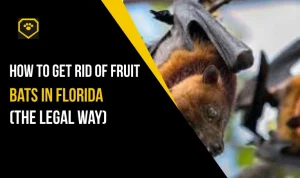
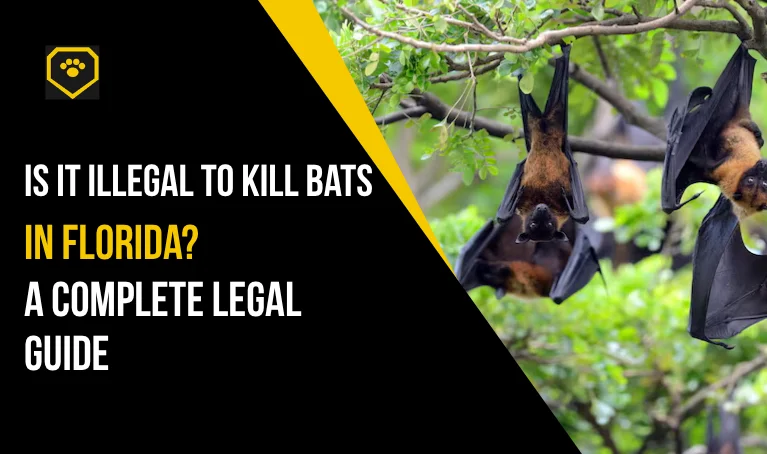
If bats have gotten into your attic, soffit, or wall void, the first instinct for many Florida homeowners is to find a way to get rid of them fast. Pest control sprays, rodenticides, or physical trapping might seem like quick solutions — but every one of those approaches is illegal in Florida, and in some cases a federal crime. Understanding exactly what the law says before you take action can save you from serious fines, legal exposure, and a situation that ends up far worse than where you started. Here’s the complete picture of bat law in Florida and what you can legally do instead.
The Short Answer: Yes, It Is Illegal to Kill Bats in Florida
Killing bats in Florida is illegal under both state and federal law. There are no exceptions for private property, no self-defense provisions, and no exemptions based on the size of the colony or the extent of the damage the bats are causing. The only lawful method of bat removal in Florida is exclusion — a process that allows bats to leave a structure voluntarily but prevents them from returning. Extermination is not a legal option under any circumstances.
Helpful for you: Bat Scat Identification Guide
What Florida Law Says About Bats
Florida bats are classified as non-game wildlife under Florida Statute 379.2291. This statute prohibits taking, harassing, pursuing, hunting, molesting, capturing, or killing non-game wildlife — which includes all native bat species — without a valid permit issued by the Florida Fish and Wildlife Conservation Commission (FWC).
Florida Administrative Code Rule 68A-4.001 reinforces this protection, explicitly stating that all native non-game wildlife in Florida is protected by default. There are no bat species in Florida that are classified in a way that permits unrestricted killing by private citizens.
Violations of Florida’s non-game wildlife protections are criminal offenses. A first violation is a second-degree misdemeanor under Florida law, with penalties including fines and potential jail time. Repeat violations carry escalating penalties.
Must Read: How to Identify Bat Tracks
Federal Laws That Protect Florida Bats
Two of Florida’s bat species receive protection not just under state law but under federal law through the Endangered Species Act (ESA), administered by the U.S. Fish and Wildlife Service (USFWS):
- Florida bonneted bat (Eumops floridanus): Listed as federally endangered under the ESA. Found in Central and South Florida, this is the largest native bat in the state. Killing, harming, harassing, pursuing, hunting, shooting, wounding, trapping, capturing, or collecting a Florida bonneted bat is a federal crime.
- Tri-colored bat (Perimyotis subflavus): Listed as threatened under the ESA as of November 2023, following severe population declines caused by white-nose syndrome. This small species is found throughout Florida and was historically common in buildings and tree roosts. It is now subject to the same federal protections as the Florida bonneted bat.
Federal ESA violations carry penalties of up to $50,000 per violation and up to one year of imprisonment for threatened species violations, and up to $100,000 per violation and up to one year of imprisonment for endangered species violations. Criminal penalties are higher. These are per-incident figures — a single poisoning event affecting a colony could result in multiple violation charges.
Because it is impossible to visually identify bat species with certainty in a roosting colony, any extermination attempt risks killing a listed species. This is a significant legal exposure that homeowners and pest control operators often underestimate.
Also Read: Bat Sound Identification Guide
Which Specific Actions Are Illegal When Dealing With Bats in Florida?
The following actions are prohibited under Florida law and/or federal law:
- Using pesticides, rodenticides, or other poisons to kill bats — Pesticide labels are federal law under FIFRA. No pesticide registered for use in the United States is labeled for use against bats, meaning applying any pesticide to kill bats is an off-label use that constitutes a federal FIFRA violation in addition to a state wildlife violation.
- Physically killing bats by trapping and disposing of them — Lethal cage trapping or any form of direct physical killing is prohibited.
- Using glue traps or snap traps in bat roosts — These are lethal devices and their use against protected wildlife is illegal.
- Sealing bats inside a structure so they cannot exit — Even if the intent is to exclude rather than kill, sealing an entry point while bats are inside results in their death, which constitutes an illegal taking under Florida law.
- Performing bat exclusion during the maternity season — Florida law prohibits bat exclusion on residential structures between April 15 and August 15. Performing exclusion during this window traps non-flying pups inside, resulting in their death — an illegal outcome regardless of intent.
Is There a Self-Defense Exception for Bats in Florida?
Unlike some other Florida wildlife laws — such as the provision allowing homeowners to kill a venomous snake in immediate self-defense — there is no self-defense exception for bats under Florida law. If a bat is inside your living space and you believe you or someone in your household has been exposed to it, the correct response is containment and professional removal, not killing.
If a bat is found in a room where someone was sleeping, or if there is any chance a bat could have made contact with a person who was asleep or incapacitated, the situation should be treated as a potential rabies exposure. Contact the Florida Department of Health (or your county health department) and do not kill or release the bat before confirming whether it should be submitted for rabies testing. A bat submitted for testing must be intact — a bat that has been killed in a way that damages its head cannot be tested, which may require the exposed person to undergo post-exposure prophylaxis (a series of rabies shots).
What You Can Legally Do About Bats in Florida
Florida law provides one legal pathway for removing bats from a structure: exclusion. Exclusion is a non-lethal removal technique that allows bats to exit the roosting site through one-way devices but prevents them from re-entering once they have left.
1. Contact a Licensed Nuisance Wildlife Trapper
Bat exclusion is the type of work where professional expertise directly affects the outcome. A licensed wildlife trapper will identify the species, estimate the colony size, locate every entry point (bats use gaps as small as 3/8 inch by 1 inch), and install exclusion devices correctly. Incomplete exclusions — where even a single entry point is missed — result in the colony remaining partially or fully in place.
2. Time the Exclusion Correctly
Exclusion may only be legally performed on residential structures outside of Florida’s bat maternity season, which runs from April 15 through August 15. Outside this window — from August 16 through April 14 — exclusion is legal and can proceed. If you discover bats during the maternity season, use that time to have an inspection performed, document all entry points, and plan the exclusion for the first day it is legally permitted.
3. Understand That No Permit Is Required for Exclusion Itself
Property owners and licensed wildlife trappers do not need a special FWC permit to perform bat exclusion outside the maternity season. The permit restriction applies to activities that harm or capture bats — exclusion that allows bats to exit voluntarily is lawful as long as it is timed correctly and performed in a way that does not harm the animals.
4. Have the Roosting Area Cleaned After Exclusion
Bat guano accumulates in roosting areas and requires proper remediation after the colony has been excluded. Guano can harbor Histoplasma capsulatum, a fungal pathogen that causes histoplasmosis when disturbed. Professional cleanup using appropriate respiratory protection, removal of contaminated insulation, and treatment of the roosting area is recommended. This is not a DIY task.
5. Seal the Entry Points Permanently and Inspect Annually
Once exclusion is complete, all entry points should be sealed with durable, permanent materials — metal flashing, caulk, hardware cloth — that will not deteriorate within a season. Florida’s heat, UV exposure, and rainfall degrade caulk and foam over time, so an annual inspection of the sealed entry points is recommended to catch any deterioration before bats can re-enter.
What Happens If Someone Violates Florida Bat Laws?
Florida bat law violations are reported to the FWC Wildlife Alert Hotline and investigated by FWC officers. Federal ESA violations involving the Florida bonneted bat or tri-colored bat are investigated by USFWS Office of Law Enforcement agents. Violators can face:
- Criminal misdemeanor charges under Florida Statute 379.2291 for state violations
- Civil and criminal penalties under the ESA for federal violations involving listed species
- Additional FIFRA violations if pesticides were used illegally
Pest control companies that offer to exterminate bats — whether using pesticides, sealing bats inside, or other lethal methods — are operating outside the law and exposing both themselves and the property owner to legal liability. If a pest control company proposes any method for bat removal other than exclusion, do not hire them for that work. To report a suspected illegal bat killing in Florida, contact the FWC Wildlife Alert Hotline at 1-888-404-FWCC (3922).
Florida Bat Law Summary
| Action | Legal Status |
|---|---|
| Killing bats with pesticide or poison | Illegal — state and federal (FIFRA) violation |
| Physically killing or trapping bats | Illegal — state wildlife law violation |
| Sealing entry points with bats inside | Illegal — results in illegal taking |
| Bat exclusion during maternity season (Apr 15–Aug 15) | Illegal — prohibited by Florida law |
| Bat exclusion outside maternity season | Legal — the only lawful removal method |
| Killing a Florida bonneted bat or tri-colored bat | Federal crime — ESA violation |
| Installing bat exclusion professionally | Legal outside maternity season |
| Installing a bat house as an alternative roost | Legal and encouraged by FWC |
How CFL Trappers Can Help You
Central Florida Trapper provides licensed bat inspection, exclusion, and guano remediation services throughout Central Florida, including Orlando, Kissimmee, Tampa, Lakeland, and the surrounding areas. If you have bats in your attic, soffits, or wall voids, our team can identify the species, document all entry points, and implement a complete exclusion plan that complies with Florida’s maternity season restrictions and all applicable state and federal laws. We carry all required FWC permits and have extensive experience handling both small single-colony exclusions and large-scale structural bat problems. Call 813-566-9453 any day of the week — emergency dispatch is available 24/7.
Conclusion
Killing bats in Florida is illegal under state wildlife law, and killing federally listed species like the Florida bonneted bat or tri-colored bat is a federal crime under the Endangered Species Act. There are no exceptions for private property or colony size, and there is no self-defense provision for bats as there is for some other Florida wildlife. The only lawful removal method is exclusion, and exclusion must occur outside the April 15 through August 15 maternity season. If you have bats in your home, the right response is to call a licensed wildlife trapper — not to attempt extermination. The legal and practical risks of trying to kill bats in Florida far outweigh any short-term convenience, and exclusion, done correctly, resolves the problem permanently.
Frequently Asked Questions About Bat Laws in Florida
Is it illegal to kill a bat in self-defense in Florida?
There is no self-defense exception for bats under Florida law, unlike the limited provision that exists for venomous snakes. If a bat is inside your living space, the correct response is to contain the bat and call a professional or your local animal services. If there is any possibility of human contact, contact the Florida Department of Health before killing or releasing the bat, as the bat may need to be submitted for rabies testing.
Can pest control companies kill bats in Florida?
No. Pest control companies are not legally permitted to use any pesticide or lethal method against bats. No U.S.-registered pesticide is labeled for use against bats, meaning any pesticide application against bats constitutes an illegal off-label use under FIFRA. Any pest control company that offers to “exterminate” bats is violating federal and state law. Bat removal must be performed through exclusion, which is the domain of licensed nuisance wildlife trappers, not traditional pest control companies.
What are the penalties for killing bats in Florida?
Killing a bat in Florida is a criminal misdemeanor under Florida Statute 379.2291. If the bat killed is a Florida bonneted bat (federally endangered) or a tri-colored bat (federally threatened), federal ESA penalties apply — up to $50,000 per violation and up to one year of imprisonment for threatened species, and higher penalties for endangered species violations.
When can I legally remove bats from my home in Florida?
Bat exclusion — the only legal removal method — can be performed between August 16 and April 14 (outside the April 15 through August 15 maternity season). During the maternity season, exclusion is prohibited because it traps non-flying pups inside the structure. If you discover bats during the maternity season, have a professional inspect the structure and plan the exclusion for after August 15.
Does homeowner’s insurance cover bat damage?
Most standard homeowner’s insurance policies in Florida exclude coverage for damage caused by bats, rodents, and other wildlife as a maintenance issue rather than a sudden loss event. Some policies offer wildlife endorsements that provide coverage for exclusion and remediation costs, but this varies significantly by insurer and policy. Review your policy carefully and contact your insurance agent if you are unsure what your coverage includes. Delaying bat exclusion due to insurance questions typically results in more damage and higher eventual costs.
What is the bat maternity season in Florida?
Florida’s bat maternity season runs from April 15 through August 15 each year. During this period, bat exclusion is prohibited on residential structures under Florida law. The restriction exists to protect nursing female bats and their non-flying pups, which cannot exit exclusion devices on their own and would die if adults were excluded from the roost during this period.