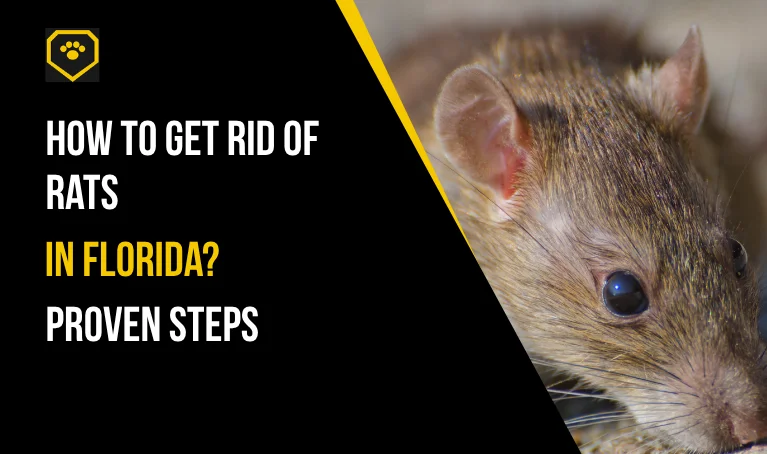
Rats in Florida are not a seasonal problem — they are a year-round reality. The state’s two most common species, the roof rat and the Norway rat, thrive in Central Florida’s warm climate, dense vegetation, and residential environments. Once a rat colony establishes inside a structure, it rarely goes away without intervention. The steps below explain how to identify an infestation, remove the rats, and prevent them from returning through proper exclusion and sanitation methods.
Areas Around Florida Homes That Attract Rats
Rats need food, water, and shelter — and most Florida residential properties provide all three without the homeowner realizing it. The following features consistently draw rats onto and into structures:
- Fruit trees — citrus, avocado, mango, and palms are major attractants for roof rats
- Bird feeders, outdoor pet food bowls, and unsecured compost bins
- Overgrown shrubs, dense ground cover, and ivy touching the exterior wall
- Unsecured garbage cans and dumpsters near the structure
- Wood piles, debris piles, and storage items stacked against the foundation
- Leaky irrigation heads, AC condensate drains, and dripping outdoor faucets
- Palm trees and tall oaks with canopy touching or overhanging the roofline
- Open soffits, unscreened attic vents, and worn fascia boards on older homes
- Unsealed utility penetrations, plumbing chases, and crawl space entries
Signs You May Have Rats in Your Florida Home
Rats are nocturnal and stay hidden during the day, but they leave behind unmistakable evidence. Multiple signs together strongly suggest an active infestation:
- Scratching, scurrying, or rolling sounds in the attic, walls, or ceiling — especially at night
- Droppings: dark, pellet-shaped, half to three-quarter inch long (roof rat) or larger capsule-shaped (Norway rat)
- Gnaw marks on wood trim, drywall, electrical wiring insulation, or food packaging
- Grease rub marks along wall edges and baseboards from rat fur
- Nesting material — shredded insulation, paper, fabric — found in attics or storage areas
- Foot tracks and tail drag marks in dusty or soft areas of the attic floor
- Chewed fruit on trees, especially at the top where roof rats forage
- Urine stains visible under UV light in attics and crawl spaces
Also Read: Roof Rat vs Norway Rat in Florida
How to Get Rid of Rats in Florida
Rat control in Florida requires a sequential, layered approach. Trapping without exclusion will result in re-infestation. Exclusion without trapping will trap rats inside. The ten steps below cover the complete process from identification to long-term prevention.
1. Confirm the Species — Roof Rat or Norway Rat
Florida has two primary rat species, and each requires a slightly different control strategy. The roof rat (Rattus rattus) is the most common in Central Florida — it is a sleek, dark-furred climber that lives in attics, ceilings, palm trees, and overhead vegetation. Its droppings are pointed at both ends and roughly half an inch long. The Norway rat (Rattus norvegicus) is larger, heavier, and a burrower — found in crawl spaces, under slabs, in drainage areas, and along embankments. Its droppings are larger with blunt ends. Correctly identifying the species before you set traps matters because roof rats are caught most effectively with snap traps placed in elevated runs, while Norway rats are best targeted at ground level along burrow entrances. Misidentifying the species leads to traps in the wrong locations and poor results.
2. Inspect the Entire Structure for Entry Points
Before setting a single trap, walk the entire exterior of the structure and look for every gap, crack, and opening larger than a quarter inch. Rats can compress their bodies to fit through remarkably small openings — a roof rat can enter through a hole the diameter of a quarter. Focus the inspection on: the roofline and fascia (roof rats enter here most often), soffit seams and vents, where pipes and conduit penetrate the wall, the foundation sill plate and crawl space vents, gaps around garage door frames and worn door sweeps, and any utility chase or plumbing access panel. Use a bright flashlight and probe stick to test the integrity of soffit material and fascia boards — rotted wood often conceals larger gaps. Document every opening because they all need to be sealed as part of exclusion.
3. Remove All Exterior Food and Water Sources
Trapping is far less effective when rats have abundant food available outside the home. Before setting traps, remove or secure every food source on the property. Pick up fallen fruit every day — citrus, avocado, figs, and palm fruit are the single biggest rat attractant in Central Florida. Move bird feeders away from the structure or remove them entirely during the control period. Store pet food in sealed metal or hard plastic containers indoors. Secure garbage cans with locking lids. Fix dripping faucets, irrigation heads, and AC condensate drains that create standing water. Cut back overgrown vegetation touching the structure. These steps will not eliminate rats already inside, but they stop new rats from being drawn to the property while you work the interior.
Also Read: How to Identify Rat Scat/Droppings
4. Set Snap Traps in High-Activity Areas
Snap traps are the most effective, fastest-acting, and most humane method for reducing an active rat population inside a structure. For roof rats in an attic: place traps along the perimeter walls and rafters, perpendicular to the wall with the trigger end facing the wall. Bait with peanut butter, nesting material, chocolate, or dried fruit. For Norway rats at ground level: place traps against walls, under appliances, and along burrow entrances. Set a minimum of six to ten traps for an active infestation — under-trapping is the most common mistake homeowners make. Check traps every 24 to 48 hours and reset immediately. Do not use glue traps in attics: they catch non-target animals and cause unnecessary suffering without reducing the rat population efficiently.
5. Use Bait Stations as a Secondary Measure
Rodenticide bait stations — tamper-resistant boxes containing anticoagulant bait — can supplement snap trapping for large or persistent infestations. However, bait stations carry important risks in Florida that must be managed carefully. Secondary poisoning: rodenticides kill rats slowly, during which time they may be eaten by owls, hawks, dogs, or cats — poisoning those animals as well. In Florida, this is a real risk given the density of raptors and outdoor pets. Second-generation anticoagulants carry the highest secondary poisoning risk and should not be used inside structures or in areas accessible to wildlife. If you use bait stations, keep them inside tamper-resistant boxes in areas inaccessible to children, pets, and wildlife. Bait stations should always be combined with exclusion — they reduce the population but will not solve a structural access problem.
6. Seal All Entry Points With Rodent-Proof Materials
Exclusion — permanently sealing every entry point in the structure — is the single most important step in long-term rat control, and it is the step most homeowners skip or do partially. Trapping alone will never permanently solve a rat problem because new rats from outside will continue to enter through the same access points. Materials for exclusion must be rodent-proof: 16- or 19-gauge hardware cloth, sheet metal flashing, copper mesh, concrete, or high-quality polyurethane foam combined with hardware cloth. Standard caulk, spray foam alone, and wood will be gnawed through. Seal every opening found during the inspection in a single session if possible — partially excluding a structure with active rats inside creates problems because trapped rats become more destructive and agitated. Exclusion should follow a period of active trapping that has reduced the interior population first.
Must Read: How to Identify Rat Tracks in Florida
7. Trim Trees and Remove Roof-Level Access
Roof rats in Florida almost exclusively use tree canopy, palms, and overhead utility lines to reach the roofline before entering through soffit gaps and fascia. Cutting back branches to maintain at least a six-foot clearance between tree canopy and the roofline removes the most common highway that roof rats use. This is especially important for properties with citrus trees, large oaks, palms, and any tree with branches hanging over the roof. Metal rat guards installed on tree trunks and utility poles prevent climbing. Trim ivy, jasmine, and bougainvillea off the exterior walls — these vines provide both cover and a climbing surface. Exterior vegetation management significantly reduces the rate of re-infestation after exclusion is complete.
8. Clean Out the Attic and Decontaminate
Once trapping has stopped and no new activity is detected for at least five to seven consecutive days, the attic should be cleaned and decontaminated before re-insulation or storage is returned. Rat urine and feces carry disease pathogens including leptospirosis — both present in Florida. Contaminated insulation should be removed and replaced. All surfaces should be sprayed with an EPA-registered disinfectant and allowed to dry before new insulation is installed. Nesting material and dead rats must be double-bagged and disposed of in sealed containers. Protective equipment including an N95 or better respirator, disposable gloves, goggles, and Tyvek suit is required for safe attic remediation. This is where most homeowners appropriately choose to hire a professional for safety and to ensure complete removal of contaminated material.
Helpful for you: What Rats Sound Like in Your Home
9. Replace or Repair Damaged Insulation
Attic insulation damaged by rats loses a significant portion of its thermal value and is a persistent source of odor, bacteria, and allergens. Blown-in insulation is the most practical replacement choice for Florida attics. The insulation replacement is best done after exclusion is verified complete — installing new insulation before all entry points are sealed results in immediate re-contamination. Full attic restoration after a serious rat infestation typically includes insulation removal, structural disinfection, and new insulation installation. Some Florida homeowners recover a portion of this cost through homeowner’s insurance if the infestation caused documented structural damage — worth a call to your insurance agent before committing to remediation costs.
10. Maintain Ongoing Rodent Monitoring
Rat control is not a one-time event in Florida — it requires ongoing monitoring, especially in neighborhoods with heavy tree cover, older housing stock, or nearby commercial properties. After exclusion is complete, maintain two to four snap traps or monitoring stations in the attic year-round and check them monthly. Walk the exterior perimeter twice a year to check for new gaps, gnaw damage, or deteriorating exclusion material. Keep up with fruit tree management and exterior food sources. If you see fresh droppings, hear activity, or catch anything in monitoring traps, re-inspect the exclusion immediately — there is a new entry point somewhere. Properties that maintain this routine inspection schedule rarely experience a full re-infestation.
Best Rodent Control Products for Florida Homes
The products below have a consistent track record in Florida’s humid, high-activity rodent environment.
| Product Type | Best Use | Effectiveness | Safety Concerns | Notes |
|---|---|---|---|---|
| Victor snap traps | Attic, interior runs | High | Low — keep away from pets | Best ROI; fast kill; reusable |
| Electronic snap traps | Kitchens, garages, interior | High | Very low | No blood; sensor-activated |
| Tamper-resistant bait stations | Exterior perimeter, crawl spaces | High (long-term) | Secondary poisoning risk | Use first-gen anticoagulants near wildlife |
| Hardware cloth (half-inch) | Exclusion of vents, gaps | Permanent | None | Must be properly stapled or screwed |
| Copper mesh (Stuf-it) | Pipe gaps, irregular openings | Permanent | None | Cannot be gnawed; pairs well with foam |
| Sheet metal flashing | Fascia, soffit seams, corners | Permanent | None | Best for roofline exclusion in Florida |
How to Keep Rats From Coming Back
- Inspect soffit, fascia, and attic vents every six months for new gaps or deterioration
- Pick up fallen fruit daily during citrus and mango season
- Store bird seed, pet food, and grains in sealed metal containers indoors
- Keep vegetation trimmed at least six feet away from the roofline
- Maintain active snap traps in the attic year-round as a monitoring system
- Check crawl space vents and foundation sill plates seasonally
- Fix dripping faucets, irrigation heads, and condensate drain issues that create standing water
- Coordinate with neighbors on shared tree trimming and exterior food source management
- Schedule a professional rodent inspection annually for properties with a history of activity
How CFL Trappers Can Help You
CFL Trappers provides professional rat removal services in Central Florida, starting with a full inspection to identify entry points, nesting areas, and active rat movement inside and around the structure. The team then uses targeted trapping methods to reduce the infestation and remove rats from attics, crawl spaces, and wall voids safely and effectively. After removal, all key entry points are sealed using rodent-proof materials to stop future access, followed by prevention guidance to reduce the chances of reinfestation.
Conclusion
Rats in Florida will not leave on their own, and partial solutions always fail eventually. The only approach that works long-term is the full sequence: confirm the species, eliminate food sources, trap the interior population down, seal every entry point, decontaminate, and maintain the structure going forward. Central Florida Trapper handles every step of this process for homeowners throughout the region.
FAQs
What kind of rats are in Florida homes?
The two most common rats in Florida homes are the roof rat (Rattus rattus) and the Norway rat (Rattus norvegicus). Roof rats are by far the more common species in Central Florida homes, particularly in attics. They are dark, sleek climbers that use tree canopy and rooflines for access. Norway rats are larger burrowers found more commonly in crawl spaces, drainage areas, and commercial settings.
How do rats get into Florida homes?
Roof rats most commonly enter through gaps in the roofline: open soffits, unsealed attic vents, fascia gaps, and utility penetrations at the roofline level. They reach these entry points by climbing trees, palms, and utility lines that overhang or touch the roof. Norway rats enter at ground level through foundation gaps, crawl space vents, and sewer-connected drains. Any gap larger than a quarter inch is a potential entry point.
How long does it take to get rid of rats in a Florida home?
A typical residential rat control program — inspection, trapping, and exclusion — takes two to four weeks from start to finish for an average infestation. Heavier infestations or those requiring full attic remediation and re-insulation can take longer. Ongoing monitoring should continue indefinitely after the initial program is complete.
Will rats leave on their own once food is removed?
Rarely, once they are established inside a structure. Rats that are nesting in your attic or walls have found shelter, and they will adapt their foraging rather than abandon a secure nest site. Removing exterior food sources is a critical supporting step, but it will not cause an established interior colony to self-vacate. Active trapping and exclusion are required to resolve an infestation that has reached the interior of a structure.
Are rat bait stations safe around pets in Florida?
Tamper-resistant bait stations used correctly pose a low direct risk to children and pets, but secondary poisoning of raptors and other wildlife is a real concern in Florida. If you use bait stations outdoors, use first-generation anticoagulants rather than second-generation products, and always use properly secured tamper-resistant boxes placed away from wildlife habitat and pet access areas.