Most Florida rat problems get blamed on “rats” without ever pinning down which species is actually responsible — and that matters more than it sounds. Roof rats and Norway rats look similar at a glance, but they nest in completely different parts of a property, react to different bait setups, and call for different exclusion work. Misidentify the species and the same problem keeps coming back. This guide breaks down the ten key differences between roof rats and Norway rats in Florida, so you can identify what you are dealing with before spending a dollar on traps or bait.
What Are Roof Rats?
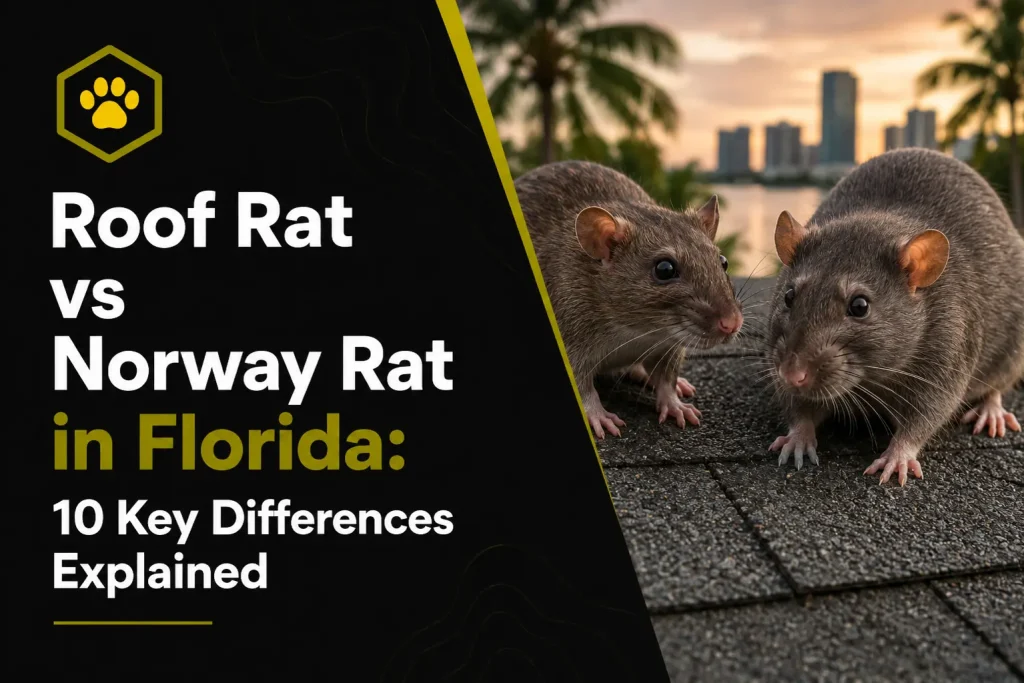
Roof rats (Rattus rattus) are agile climbing rodents commonly found in Florida attics, palm trees, roofs, and upper portions of structures. They are also known as black rats, fruit rats, or palm rats because of their dark coloration and strong preference for fruit-bearing trees and elevated nesting areas. Unlike heavier ground-dwelling rats, roof rats are built for vertical movement, with slim bodies, long tails, sharp claws, and excellent balance that allow them to travel across fences, utility lines, and rooflines with ease.
In Florida, roof rats are the most common rat species found in residential neighborhoods. They thrive in warm climates with dense landscaping, citrus trees, palm fronds, and tile roofs that provide easy shelter and travel routes. Most attic infestations throughout Central Florida are caused by roof rats entering through soffits, roof vents, damaged fascia, or small gaps around utility penetrations. Once inside, they contaminate insulation, chew wiring, damage ductwork, and reproduce quickly if entry points are not sealed properly.
Also Read: How to Identify Rat Tracks
What Are Norway Rats?
Norway rats (Rattus norvegicus) are large, heavy-bodied rodents that live primarily at ground level and below structures rather than above them. Commonly called brown rats, sewer rats, or wharf rats, they are known for their burrowing behavior and ability to thrive around dumpsters, drainage systems, crawl spaces, foundations, and commercial garbage areas. Their thick build, blunt snout, and shorter tail distinguish them from the slimmer and more agile roof rat.
Unlike roof rats, Norway rats are poor climbers and prefer low, hidden nesting locations where they can tunnel through soil and stay close to food and water sources. In Florida, they are less common in suburban attics but frequently appear around older neighborhoods, restaurants, waterfront areas, storm drains, and properties with structural gaps near the foundation. Norway rats are highly destructive because they chew aggressively, contaminate food sources, undermine slabs with burrowing activity, and spread bacteria through droppings and urine concentrated near ground-level nesting zones.
Roof Rat vs Norway Rat: 10 Key Differences
Both species belong to the genus Rattus and both are non-native to Florida, but the similarities mostly end there. The ten differences below cover the traits that actually change how you control them — size, anatomy, behavior, droppings, nesting, and habitat preference.
1. Body Size and Weight
Roof rat: Adult roof rats (Rattus rattus) are the smaller of the two species, measuring six to eight inches in body length and weighing five to nine ounces. Their slim, sleek build is built for climbing, jumping, and squeezing through tight gaps in soffits, vents, and palm fronds.
Norway rat: Norway rats (Rattus norvegicus) are noticeably larger and heavier, with adults reaching seven to ten inches in body length and ten to eighteen ounces in weight — sometimes more. Their thick, stocky build suits a ground-based, burrowing lifestyle but limits how high they can climb.
2. Tail Length and Appearance
Roof rat: A roof rat’s tail is longer than its body — typically seven to ten inches — thin, dark, and used for balance while climbing trees, fences, and utility lines. The tail makes it instantly identifiable when one is spotted running across a soffit at dusk.
Norway rat: A Norway rat’s tail is shorter than its body — usually six to eight inches — thicker, scaly, and bi-colored (darker on top, paler underneath). It is not used for climbing balance to anywhere near the same degree.
3. Body Shape and Build
Roof rat: The roof rat has a sleek, slim, elongated body that tapers toward the head. Everything about its build supports vertical movement — light frame, long limbs, sharp claws.
Norway rat: The Norway rat has a heavy, robust, almost cylindrical body. The bulk gives it digging power and helps it tunnel through soil and pack burrows under foundations, but makes it slow up walls and unable to navigate thin branches.
Helpful for you: What Rats Sound Like in Your Home
4. Snout, Eyes, and Ears
Roof rat: The face is pointed, with a long narrow snout, large prominent eyes, and ears that are oversized relative to the body. Up close, a roof rat looks alert and almost mouse-like in its features.
Norway rat: The face is blunt, with a short stubby snout, small beady eyes, and ears that look small relative to the heavy head. The expression is dull compared to a roof rat.
5. Fur Color and Texture
Roof rat: Fur is short, smooth, and ranges from black to dark brown, with a lighter gray or cream-colored belly. The coat looks neat and slick.
Norway rat: Fur is coarse, shaggy, and ranges from brown to gray-brown, with a dirty white or gray belly. The coat looks rougher and less groomed, especially on older adults.
6. Droppings
Roof rat: Droppings are about half an inch long, spindle-shaped, and pointed at both ends. They typically appear in scattered piles on attic insulation, along rafters, and on top of stored boxes — anywhere the rat is traveling.
Norway rat: Droppings are larger — about three-quarters of an inch long — capsule-shaped with blunt, rounded ends. They are usually found in concentrated piles near burrow entrances, along baseboards, and around food sources at ground level.
Helpful for you: Rat Scat/Droppings Identification Guide
7. Climbing Ability
Roof rat: Roof rats are excellent climbers. They scale stucco walls, tile roofs, palm trees, utility lines, and fences with ease. The species is named for this behavior — it lives high, not low, and accesses Florida homes almost entirely from above.
Norway rat: Norway rats are poor climbers. They occasionally negotiate a fence or low wall but cannot manage a tree, utility line, or vertical stucco surface. Their world is the ground floor, the slab, and the soil underneath.
8. Nesting Location
Roof rat: Nests are built in elevated, sheltered locations — attics, soffit cavities, palm tree crowns, ivy-covered fences, dense shrubs, and unused chimneys. A typical Florida attic infestation is almost always roof rats.
Norway rat: Nests are built in burrows in the ground or in low cavities — under decks, sheds, AC pads, foundations, and inside crawl spaces. Norway rats prefer soil they can dig into and rarely venture above the first floor of a structure.
9. Diet and Feeding Habits
Roof rat: Roof rats prefer fruit, nuts, seeds, citrus, mangoes, avocados, and grain. They are agile enough to feed directly off the tree, which is why fruit is left half-eaten on the branch in heavy Florida infestations. Many homeowners call them “fruit rats” or “palm rats” for this reason.
Norway rat: Norway rats are far more opportunistic omnivores. They eat meat scraps, fish, pet food, grain, garbage, eggs, and just about anything organic on the ground. They are the species that thrives around dumpsters, garbage transfer stations, and waterfront restaurants.
10. Habitat and Where They Show Up in Florida
Roof rat: Roof rats dominate residential Florida. The warm climate, dense canopy, palm trees, tile roofs, and fruit-bearing landscaping match exactly what they prefer. In Central Florida, almost every “rat in the attic” call is a roof rat.
Norway rat: Norway rats are less common in suburban Florida but do show up around commercial dumpsters, sewer systems, ports, marinas, and older neighborhoods with crawl spaces and slab issues. They are the dominant urban rat across much of the rest of the country, but Florida’s environment tilts heavily toward the roof rat.
Which Rat Is More Common in Central Florida?
The roof rat is the dominant species across Central Florida by a wide margin. Tile roofs, palm fronds, mango and citrus trees, dense ornamental landscaping, and warm year-round nights match exactly what they prefer. Norway rats do exist in the region, especially around commercial properties, drainage canals, sewer access points, and older slab-on-grade neighborhoods, but a residential rat problem in the Orlando metro area is almost always a roof rat issue.
Signs You Have Roof Rats
- Scratching, scampering, and rolling sounds in the attic at night
- Pointed half-inch droppings on top of insulation and along rafters
- Greasy rub marks along roof trusses, rafters, and pipe penetrations
- Citrus, mango, or avocado hollowed out and left on the branch
- Chewed soffit corners, roof vents, and gable vent screening
- Trails through palm fronds and along fence-top utility lines
- Cats or owls fixating on rooflines and tree canopies at dusk
Signs You Have Norway Rats
- Burrow holes two to three inches wide along foundations, decks, and garbage areas
- Blunt three-quarter-inch droppings in concentrated piles near burrows
- Smear marks low to the ground along walls and pipes
- Gnawed holes near floor level in garages, sheds, and crawl spaces
- Rats spotted near dumpsters, compost bins, or storm drains
- Worn dirt trails between burrow entrances and food sources
- Tunnel networks under outbuildings, AC pads, and pool equipment
How to Get Rid of Roof Rats and Norway Rats
The control strategy depends on which species you have, but the underlying logic is the same: remove food, seal entries, and trap inside while baiting outside. The key adjustments are where you trap and where you seal.
- Confirm the species using the differences above before buying traps or bait
- Eliminate food sources — pick fruit early, secure pet food, lock down trash
- Trim tree branches at least six feet from the roof to cut roof rat highways
- Seal every gap larger than a quarter inch — soffits and vents for roof rats; foundations and crawl space entries for Norway rats
- Install ¼-inch hardware cloth on all vents
- Use snap traps in the active zones — rafters and attic walls for roof rats; baseboards and burrow entrances for Norway rats
- Fill in Norway rat burrows with gravel and concrete patch after confirming they are inactive
- Use tamper-resistant bait stations along the foundation outdoors, never loose bait
- Replace chewed insulation, soiled ductwork, and gnawed wiring after population is removed
- Bring in a licensed exclusion specialist if signs continue — Florida homes typically have thirty to fifty potential entry points
How CFL Trappers Can Help You
Central Florida Trapper provides professional rat removal and control services across Central Florida, handling both roof rat and Norway rat infestations with full-property inspections, attic and crawl space trapping, and exclusion work that seals every entry point. Our team identifies the species, maps the entry points, removes the active population, decontaminates affected areas, and replaces damaged insulation. We also handle post-removal repairs and yearly follow-up inspections so the same rats are not back next season. If you are hearing noises in the attic or seeing burrows along the foundation, contact us for an inspection.
Conclusion
Roof rats and Norway rats are not interchangeable. One lives in the attic and trees, the other lives in burrows and crawl spaces — and that single fact changes where you trap, where you seal, and where you set bait. Confirm the species, work the right zone of the property, and back trapping with proper exclusion. That is the difference between a one-time fix and a problem that keeps coming back every Florida winter.
FAQs
Are roof rats and Norway rats the same as “fruit rats” or “palm rats”?
“Fruit rat,” “palm rat,” and “black rat” are all common Florida names for the roof rat. They all refer to the same species, Rattus rattus. Norway rats go by “brown rat,” “sewer rat,” or “wharf rat.”
Can both species live in the same house?
It happens occasionally, but the two species usually avoid each other. Norway rats dominate ground zones and roof rats dominate elevated zones. In Florida residential settings, an attic problem is almost always roof rats.
Are rats more active in winter or summer in Florida?
Rats are active year-round in Florida, but indoor sightings spike in late fall and winter as cooler nights push them toward attic and crawl space warmth.
Do ultrasonic devices actually repel rats?
Independent testing shows ultrasonic devices have little to no lasting effect on rats. Rats adapt quickly and keep feeding and nesting near the units. Use exclusion and trapping instead.
Why are there sometimes dead rats in my attic?
Most often this is from poorly placed outdoor bait that allowed a rat to die inside. This is one reason professional inspections favor trapping inside structures and bait stations outdoors only.
How long does it take to get rid of a rat infestation in Florida?
A typical roof rat infestation in a Central Florida home takes two to four weeks to clear with proper trapping and exclusion. Larger infestations or repeated reinfestations from neighboring properties can take longer.