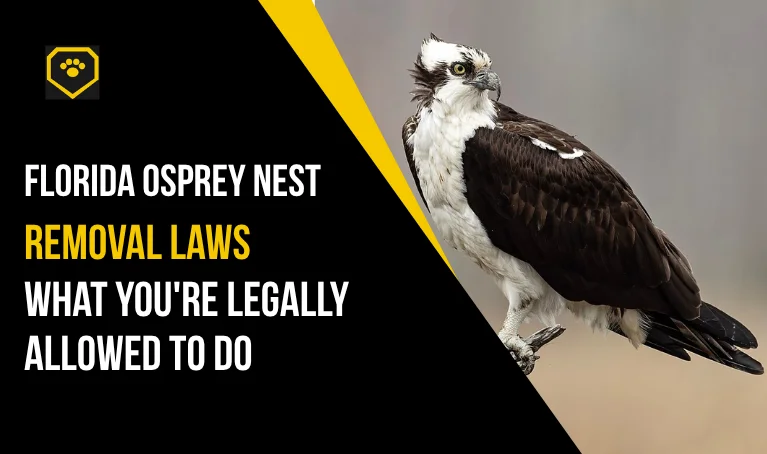
An osprey nest on your dock, boat lift, rooftop, or channel marker might seem harmless until the birds become territorial and start diving at anyone who comes near, or until the nest begins dropping debris and waste onto your property. Ospreys are powerful, persistent birds, and once they’ve selected a nesting site, they will return to it year after year. The problem for property owners is that removing an osprey nest without proper authorization is a federal crime — not a minor local ordinance violation. This guide explains what the law actually says about Florida osprey nest removal, what you are and aren’t allowed to do, and the steps you can take legally to address an osprey problem on your property.
Are Ospreys Protected Under Florida and Federal Law?
Yes — ospreys are protected under two overlapping legal frameworks, and both apply in Florida.
The primary protection comes from the Migratory Bird Treaty Act of 1918 (MBTA), a federal law administered by the U.S. Fish and Wildlife Service (USFWS). The MBTA makes it illegal to pursue, hunt, take, capture, kill, possess, sell, purchase, barter, import, export, or transport any migratory bird, or any part, nest, or egg of any such bird, without a valid federal permit. The osprey (Pandion haliaetus) is listed as a migratory bird under the MBTA and is fully protected. At the state level, ospreys are also protected as non-game wildlife under Florida Statute 379.2291, which prohibits taking, harassing, pursuing, or killing non-game wildlife without an FWC permit. However, because osprey protection is primarily a matter of federal jurisdiction under the MBTA, the USFWS — not the FWC — is the agency responsible for issuing any permits related to osprey nest management.
What Does the Law Actually Prohibit?
Under the MBTA, the following actions related to ospreys and their nests are prohibited without federal authorization:
- Removing or destroying an active osprey nest
- Disturbing an active nest in a way that causes nest failure (eggs falling, chicks dying, adults abandoning the nest)
- Harassing ospreys at or near their nest
- Possessing osprey eggs, chicks, or nest material
- Shooting, trapping, or killing an osprey
An “active” nest under the MBTA means a nest that contains eggs, chicks, or adults that are actively incubating or brooding. It is important to understand that the MBTA’s protections extend not just to the birds themselves but to the nest and its contents. The statute does not require that the nest be on “natural” habitat. An osprey nest on your dock is as legally protected as one in a cypress tree. The bird’s choice of location is legally irrelevant — the protection travels with the nest.
Also Read: Bird Droppings Identification Guide
What Happens If You Remove an Osprey Nest Illegally?
MBTA violations are prosecuted as federal offenses. Under the statute:
- A misdemeanor violation carries fines up to $15,000 per offense and up to six months of imprisonment
- A felony violation (where the violation involves commerce or intentional taking) carries fines up to $250,000 and up to two years of imprisonment
Violations are reported to and investigated by USFWS Office of Law Enforcement agents. Prosecution does occur — particularly in cases involving repeat violations, nest destruction during active nesting, or actions that result in injury or death to birds. “I didn’t know it was illegal” is not a recognized defense under the MBTA.
When Is Osprey Nest Season in Florida?
Understanding osprey nesting timing is critical for property owners who want to plan preventive action. In Florida, ospreys nest earlier than populations in northern states due to the warmer climate. Florida osprey nesting typically runs from October through May, with egg laying most common between November and January in South and Central Florida, and January through March in North Florida. Young ospreys fledge (leave the nest) approximately 7 to 8 weeks after hatching.
In Central Florida specifically, ospreys may begin nest construction in October or November, well before the winter holidays. By the time many homeowners notice the nest is being built, it may already contain eggs or a brooding adult — at which point it is fully protected under the MBTA and cannot be legally disturbed until the young have fledged and the nest is unoccupied.
Outside of the nesting season — roughly June through September in Central Florida — ospreys may leave nesting sites temporarily, which is the window during which preventive action and structural modifications can be made.
Helpful for you: Bird Tracks Identification Guide
Is There Any Legal Way to Remove an Osprey Nest in Florida?
Yes, but only under specific circumstances and only with federal authorization.
Option 1: Wait Until the Nest Is Inactive
The simplest and most commonly available legal option for property owners is to wait until the nest is no longer active — meaning the breeding season has ended, the young have fledged, and the adults are no longer using the nest for breeding. At that point, with no eggs, chicks, or brooding adults present, the nest can generally be removed without a federal permit, provided the removal is not done in a way that is likely to harm birds.
Important caveats: ospreys frequently return to the same nest site year after year, often rebuilding and expanding the nest each season. Simply removing the nest after breeding season does not prevent the birds from returning next fall to rebuild. Physical deterrents must be installed at the same time to prevent nest reconstruction (see below).
Option 2: Apply for a USFWS Depredation or Nest Removal Permit
If an active osprey nest is causing a documented safety hazard or significant property damage, property owners can apply to the USFWS for a Special Purpose Migratory Bird Permit authorizing nest removal. These permits are not routinely granted for cosmetic or convenience reasons — the USFWS requires documentation of genuine safety or property damage concerns and typically requires that non-lethal deterrents have already been attempted without success.
To begin the permit process, contact the USFWS Migratory Bird Permit Office for Region 4 (Southeast), which covers Florida. Permit applications require information about the species, the location of the nest, the nature of the problem, and the proposed resolution. Processing times vary, and active-nest removal permits are not guaranteed to be approved.
Option 3: Prevent Nest Construction Before It Starts
The most practical legal strategy for most Florida property owners is prevention — installing deterrents on potential nest sites before ospreys begin building each season. This is the approach the USFWS itself recommends for property owners who have experienced recurring nest problems. Preventive measures that are legal under the MBTA (because they prevent nesting rather than disturbing an active nest) include:
- Installing metal or plastic spike strips on flat surfaces where ospreys land to begin nest construction
- Using reflective tape, mylar balloons, or visual deterrents near preferred nest sites during the pre-nesting window
- Placing plastic owls or other raptor decoys near existing platforms or structures (effectiveness varies and decoys must be moved regularly)
- Removing or modifying structures that ospreys favor — for example, replacing a flat-topped dock piling with a tapered or pointed cap that does not provide a stable nest platform
All of these measures are only effective when implemented before ospreys begin nest construction. Once a nest is present — even if it contains no eggs yet — any interference with the bird’s use of that nest may constitute harassment under the MBTA and is legally risky.
Must Read: Bird Sounds Identification Guide
What About Nests on Boats, Docks, and Channel Markers?
Osprey nests on waterfront structures are among the most common Florida osprey conflicts. Dock owners, marina operators, and boaters frequently discover nests on dock pilings, boat lifts, davits, and channel markers. The same legal rules apply regardless of the structure type — the nest is protected if it contains eggs, chicks, or actively brooding adults. The Florida Fish and Wildlife Conservation Commission (FWC) does not have authority to issue osprey permits — this falls entirely under USFWS jurisdiction through the MBTA. Contacting only the FWC for an osprey issue will typically result in a referral to the USFWS Migratory Bird office.
For channel markers maintained by the U.S. Coast Guard, there is a formal process for requesting nest removal through USCG in coordination with USFWS. Nests on navigation aids are addressed through an interagency process specifically because of the safety implications for navigational infrastructure.
How to Report an Osprey Disturbance or Request Guidance
If you have an osprey nest situation on your property and are unsure whether a proposed action is legal, the safest course is to contact one of the following before taking any action:
- USFWS Migratory Bird Permit Office, Region 4: The authoritative federal agency for osprey nest permits in Florida. Contact information is available at fws.gov/permits.
- FWC Wildlife Assistance: While FWC cannot issue osprey permits, their wildlife assistance line can provide guidance and referrals. Contact FWC at 1-888-404-FWCC (3922).
- A licensed nuisance wildlife trapper familiar with migratory bird law: Not all wildlife trappers handle bird issues, but those with experience in migratory bird situations can advise on legal options and coordinate with the appropriate federal and state agencies.
How CFL Trappers Can Help You
Central Florida Trapper provides licensed bird removal services in Central Florida, including Orlando, Kissimmee, Lakeland, and surrounding waterfront communities. If you have an osprey nest on your dock, roof, boat lift, or property structure, our team can assess the situation, advise you on what is legally permitted given the nest’s current status, coordinate permit inquiries with the appropriate agencies, and implement preventive measures to discourage nest reconstruction after the current breeding season ends. We operate in full compliance with both Florida wildlife law and the federal Migratory Bird Treaty Act. Call 813-566-9453 any day of the week — emergency dispatch is available 24/7.
Conclusion
Florida osprey nest removal is governed by federal law under the Migratory Bird Treaty Act, and the penalties for violating it are serious. Active osprey nests — those containing eggs, chicks, or brooding adults — cannot be disturbed or removed without a USFWS federal permit, which is not easy to obtain and is not guaranteed. The most practical options for property owners are to wait until the nest is inactive and remove it at that point, or to install physical deterrents on potential nest sites before ospreys begin building each fall. If an osprey nest is causing a genuine safety hazard, a USFWS depredation permit can be pursued, but this requires documentation, an application process, and agency approval. When in doubt, contact USFWS or a licensed wildlife professional before taking any action involving an active nest.
Frequently Asked Questions About Osprey Nest Removal in Florida
Is it illegal to remove an osprey nest in Florida?
Yes, if the nest is active. Under the federal Migratory Bird Treaty Act, removing, destroying, or disturbing an active osprey nest — one containing eggs, chicks, or brooding adults — is illegal without a USFWS federal permit. Penalties include fines up to $15,000 and up to six months of imprisonment per offense.
Can I remove an osprey nest after the birds leave?
Typically yes, once the breeding season has ended and the nest contains no eggs, chicks, or actively brooding adults. However, you should also install deterrents at the same time, since ospreys routinely return to the same nest site the following year and will rebuild if the site remains accessible.
When is osprey nesting season in Florida?
In Central and South Florida, osprey nesting begins as early as October or November, with egg laying most common between November and January. Young ospreys fledge approximately 7 to 8 weeks after hatching, meaning most nests in Central Florida are vacated by April or May. In North Florida, the nesting season runs slightly later, January through April.
What agency handles osprey permits in Florida?
Osprey permits are issued by the U.S. Fish and Wildlife Service (USFWS) Migratory Bird Permit Office, Region 4, which covers Florida. The Florida Fish and Wildlife Conservation Commission (FWC) does not have authority to issue permits for migratory birds covered by the federal MBTA.
What can I do to stop ospreys from nesting on my dock or boat lift?
Install physical deterrents — spike strips, pointed piling caps, or netting — on the structure during the off-season (June through September in Central Florida) before ospreys return in fall. These preventive measures are legal under the MBTA because they prevent nest establishment rather than disturbing an existing nest. Acting after ospreys have begun construction is legally riskier and practically more difficult.
Can ospreys nest on private property legally?
Yes. Ospreys are not required to nest on public land or natural habitat to receive federal protection. A nest on a private dock, rooftop, boat lift, or other private structure is fully protected under the Migratory Bird Treaty Act. The private nature of the property does not alter the legal status of the nest or the birds.