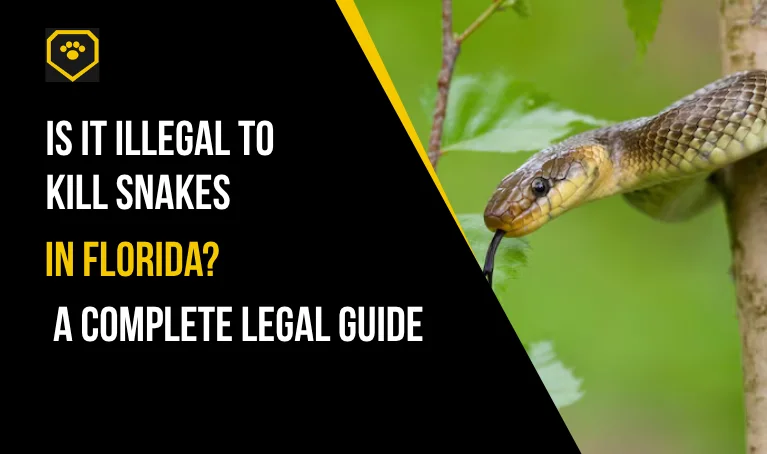
Florida homeowners and outdoor enthusiasts often ask this question, especially after spotting a snake in their yard or on a trail. The answer isn’t a simple yes or no. It depends on the snake species, the situation, and Florida wildlife regulations. In many cases, what you do next matters more than the snake itself. Understanding the law and the right response can help you avoid unnecessary risk, fines, or dangerous encounters.
The Short Answer: Most Snakes in Florida Are Legally Protected
Florida law protects the vast majority of its native snake species. Under Florida Statute 379.2291 and rules that the Florida Fish and Wildlife Conservation Commission (FWC) administers, non-game wildlife — which includes nearly all Florida snakes — cannot be taken, harassed, pursued, hunted, molested, or killed without a valid license or permit. This protection applies to both nonvenomous and venomous species. The legal framework is straightforward at a high level: the state owns snakes, not the property owner, and authorities can prosecute killing one without cause as a wildlife violation.
Which Snakes Are Protected Under Florida Law?
Florida has more than 50 native snake species, and the vast majority are classified as non-game wildlife with legal protection. The protection levels break into three categories:
- Non-game wildlife (general protection): Florida law protects all native snakes that are not separately listed. No one can kill, take, or possess them without a permit. This category includes most Florida snake species, such as corn snakes, black racers, coachwhips, king snakes, rat snakes, garter snakes, water snakes, and many others.
- Species of Special Concern / Threatened species: Florida and federal law apply extra protections to certain snakes, including the eastern indigo snake (Drymarchon couperi), which falls under the Endangered Species Act. Anyone who kills, harms, handles, or even disturbs this species can face federal charges in addition to state penalties.
- Venomous snakes: Florida also classifies venomous snakes as protected non-game wildlife, with only a narrow self-defense exception in immediate danger situations. This includes rattlesnakes, cottonmouths, copperheads, and coral snakes, which people cannot kill just for being present or causing discomfort.
Also Read: How to Get Rid of Snakes in Florida
Is It Illegal to Kill Snakes in Florida?
Yes — with a very narrow self-defense exception for venomous snakes in immediate threat situations. Here is a detailed breakdown of each relevant legal scenario Florida residents encounter.
Can You Kill a Venomous Snake on Your Own Property?
Florida law allows property owners to kill venomous snakes that pose an immediate threat to people or domestic animals. The operative phrase is “immediate threat” — the snake must be in a situation where it presents a clear and present danger, such as coiled in a doorway, cornered in a room, or in direct contact with a person or pet. This is a narrow exception, not a blanket permission to kill any venomous snake found on your property. A venomous snake crossing your yard 30 feet away is not creating an immediate threat. A pygmy rattlesnake in your garage three feet from your dog could constitute one. The FWC has been inconsistent in how it enforces this boundary, but the legal standard is clear: the danger must be immediate and unavoidable by other reasonable means. If you can simply leave the area and call a trapper, that is the legally preferred — and far safer — option. Attempting to kill a venomous snake is also the leading cause of snakebite in Florida, because people put themselves within striking range to do it.
Can You Kill a Nonvenomous Snake on Your Property?
No — the law does not allow it, and anyone who kills a nonvenomous snake can face wildlife violation charges. Florida classifies nonvenomous snakes as fully protected non-game wildlife. The law does not provide any self-defense exception for nonvenomous species because they do not pose a toxic threat. Many Florida homeowners still kill corn snakes, black racers, rat snakes, and banded water snakes because they assume they can handle any snake on their property. That assumption is incorrect. A corn snake in your attic remains legally protected. A coachwhip in your garage also remains legally protected. Florida statutes treat harming, killing, or taking these animals without a permit as a violation, regardless of fear or inconvenience. Authorities rarely issue criminal charges for first-time minor cases involving common species, but enforcement still happens, especially when cases involve protected snakes like the eastern indigo snake.
Also Read: Are There Venomous Snakes in Central Florida?
Can You Kill the Eastern Indigo Snake?
The eastern indigo snake (Drymarchon couperi) is the most legally serious snake to harm in Florida. It is listed as Threatened under the federal Endangered Species Act and as a Threatened species under Florida law. Killing, harming, harassing, pursuing, capturing, or possessing an eastern indigo snake — or even knowingly destroying its habitat — is a federal crime that can result in significant fines and prison time. Eastern indigo snakes are large, glossy blue-black snakes that can reach eight feet in length. They commonly live in sandhills, pine flatwoods, scrub habitats, and gopher tortoise burrows across Central and North Florida. Because of their large size and dark coloration, homeowners sometimes mistake them for a cottonmouth or a black racer and kill them. This mistake is extremely serious and can lead to federal consequences.
What Are the Penalties for Illegally Killing a Snake in Florida?
Penalties for violating Florida’s wildlife laws depend on the species involved and the circumstances. For most common non-game snakes, a first offense is typically a second-degree misdemeanor under Florida Statute 379.401, punishable by up to 60 days in jail, 6 months probation, and a $500 fine. Killing a species of special concern or a state-threatened species escalates to a first-degree misdemeanor, carrying up to 1 year in jail and a $1,000 fine. Violating the federal Endangered Species Act for harming an eastern indigo snake can result in civil penalties up to $25,000 per violation and criminal fines up to $50,000 plus up to one year in federal prison for a first offense. Beyond statutory penalties, FWC officers can confiscate any equipment used in the violation. The practical reality is that most casual offenses against common snake species go unenforced — but the law is on the books, enforcement does happen, and the risk of a bite while attempting to kill a snake is far higher than the risk of a fine for calling a trapper instead.
Can You Legally Relocate a Snake Instead?
Relocating a native Florida snake without a permit is also technically a violation of non-game wildlife regulations, as “taking” wildlife includes capturing and moving it. However, FWC generally does not pursue enforcement actions against homeowners who gently guide a nonvenomous snake out of a structure and release it on their property or in adjacent natural habitat. What is clearly problematic — and can constitute a violation — is relocating snakes to other properties, distant locations, or areas where they do not belong ecologically. The cleanest, safest, and most legally defensible course of action is always to call a licensed trapper who is permitted to handle, transport, and appropriately relocate native wildlife. Licensed trappers carry FWC permits that authorize them to take and move snakes on behalf of property owners.
Must Read: How to Identify Snake Droppings in Florida
Are There Any Snakes That Are Legal to Kill in Florida?
| Category | Examples | Legal Status | Key Notes |
|---|---|---|---|
| Venomous snakes posing immediate threat | Eastern Diamondback Rattlesnake, Cottonmouth, Coral Snake (only if immediate danger) | Legal in very limited situations | Only allowed if there is an immediate threat to people or domestic animals. Not a general permission. |
| Non-native invasive snakes | Burmese Python, Argentine Black & White Tegu, Nile Monitor | Legal on private land with permission (varies by area) | Can be removed or killed due to invasive status. Some public lands require permits or special authorization. |
| Native non-venomous snakes | Corn Snake, Black Racer, Scarlet Kingsnake | Illegal to kill without valid reason | Fully protected under Florida wildlife laws. Misidentification is common and risky. |
What Does FWC Say You Should Do Instead?
The FWC’s official guidance is straightforward: leave native snakes alone, and if a snake is in a location where it creates a genuine problem, contact a licensed wildlife trapper for removal. The FWC does not encourage property owners to handle, kill, or relocate snakes themselves for three reasons: the legal risk, the safety risk (most Florida snakebites happen during attempted handling or killing), and the ecological value of snakes as rodent and pest controllers. Nonvenomous snakes like rat snakes and corn snakes are among the most effective natural rodent control agents in Florida, and their removal from a property often leads to increased rodent pressure over time. The FWC Wildlife Alert Hotline (888-404-FWCC) is available 24/7 to report wildlife violations and get referrals to permitted trappers.
Helpful for you: How to Identify Snake Tracks
How to Identify Whether the Snake on Your Property Is Protected
The practical challenge is that most Florida homeowners cannot reliably identify snake species in the moment. This is exactly why the FWC’s guidance defaults to “leave it alone and call a professional.” The following distinguishing features can help narrow down the most important legal categories in the field:
- Eastern indigo snake (federal protection): Large (up to 8 ft), completely glossy blue-black, no pattern, round pupils, no rattle. Sometimes has reddish-orange coloring under the chin.
- Native nonvenomous snakes (state protected): If it has round pupils, a slender body relative to length, no rattle, and no heat-sensing pit, it is almost certainly a nonvenomous native species — fully protected.
- Venomous species (self-defense exception applies): Broad triangular head, thick body, heat-sensing pit (for pit vipers), rattle (for rattlesnakes), or red-yellow banding (coral snake). Even these are protected unless creating an immediate threat.
- Invasive non-native species (no state protection): Burmese pythons are extremely large (10+ ft), tan/brown with dark blotches, found in South Florida. Tegus are large, black-and-white lizard-like reptiles. If uncertain, do not assume invasive — err toward protection.
You May Also Like: Common Snake Sounds in Central Florida
Florida Snake Law Summary
| Snake Category | Legal to Kill? | Legal to Relocate? | Permit Required? | Penalty for Violation |
|---|---|---|---|---|
| Native nonvenomous snakes | No | Technically no (limited enforcement) | Yes, to take/move | Misdemeanor, up to $500 fine |
| Native venomous snakes | Only in immediate self-defense | No (call a trapper) | Yes, outside self-defense | Misdemeanor, up to $500 fine |
| Eastern indigo snake (federally threatened) | No | No | Federal ESA permit required | Up to $50,000 fine + federal prison |
| Other state-threatened species | No | No | Yes | First-degree misdemeanor, up to $1,000 |
| Invasive non-native species (e.g. Burmese python) | Yes (on private land w/ permission) | N/A | No (for killing) | No penalty for legal killing |
How to Report an Illegal Snake Killing in Florida
If you witness someone killing a native snake in Florida — particularly a large, glossy black snake that may be an eastern indigo — you can report it to FWC’s Wildlife Alert Hotline at 888-404-FWCC (888-404-3922). Tips can be submitted anonymously. FWC officers take indigo snake violations seriously and will investigate reports. You can also report violations online through the FWC website. For non-emergency situations involving snakes in or around a home that need removal, your best resource is a licensed nuisance wildlife trapper who is permitted and insured to handle all Florida snake species.
How CFL Trappers Can Help You
Central Florida Trapper provides licensed snake inspection and removal services across Central Florida. If you have a snake on your property — venomous or nonvenomous — our team can identify it, safely remove it, inspect your property for entry points and attractants, and advise on long-term prevention. We carry all required FWC permits and handle both routine removals and urgent venomous snake situations. Call 813-566-9453 any day of the week — emergency dispatch is available 24/7.
Conclusion
Killing a snake in Florida is almost always either illegal, unnecessarily dangerous, or both. The law protects virtually all native species, with a narrow self-defense carve-out for venomous snakes in immediate threat situations. The safest, most legal, and most practical course of action for any snake encounter on your property is to keep your distance and call a licensed wildlife trapper. Central Florida Trapper handles snake removal seven days a week across the Central Florida region.
FAQs
Can I kill a rattlesnake in my Florida backyard?
Only if it poses an immediate threat to a person or domestic animal and there is no reasonable way to avoid the danger. A rattlesnake crossing your yard without threatening anyone does not meet this standard. A rattlesnake coiled at your back door with your dog trapped nearby very likely does. When in doubt, call a trapper — it is safer, faster, and keeps you on the right side of the law.
Is it illegal to kill a water moccasin in Florida?
Yes, under the same rules that apply to all venomous snakes — they may only be killed in immediate self-defense situations. Cottonmouths are non-game wildlife protected under Florida law. They also cannot be taken, possessed, or transported without a permit. If you have cottonmouths on your property due to water features, a trapper can remove them and advise on habitat changes to reduce future activity.
What happens if I accidentally kill a protected snake?
For most common nonvenomous species, a genuine accident is unlikely to result in prosecution — but documenting what happened and reporting it to FWC is the safest course of action. If the snake turns out to be an eastern indigo snake or another specially protected species, the situation is more serious, and legal counsel may be advisable. FWC’s focus is generally on intentional violations and repeat offenders.
Can I hire someone to come kill snakes on my property?
No. Licensed wildlife trappers are permitted to capture, remove, and relocate snakes — not to kill them on your behalf recreationally or out of general nuisance concerns. Euthanasia may be authorized in specific circumstances for certain species under a nuisance wildlife permit, but wholesale killing of snakes is not a service that legally licensed trappers provide. The service is humane capture and relocation.
Are there any snakes I can legally kill in Florida without a permit?
Outside of the immediate self-defense exception for venomous snakes, the only snakes you can legally kill in Florida without a permit are confirmed invasive non-native species such as Burmese pythons on private land with landowner permission. All of Florida’s more than 50 native snake species are legally protected. If you are not 100% certain a snake is a non-native invasive, treat it as protected.