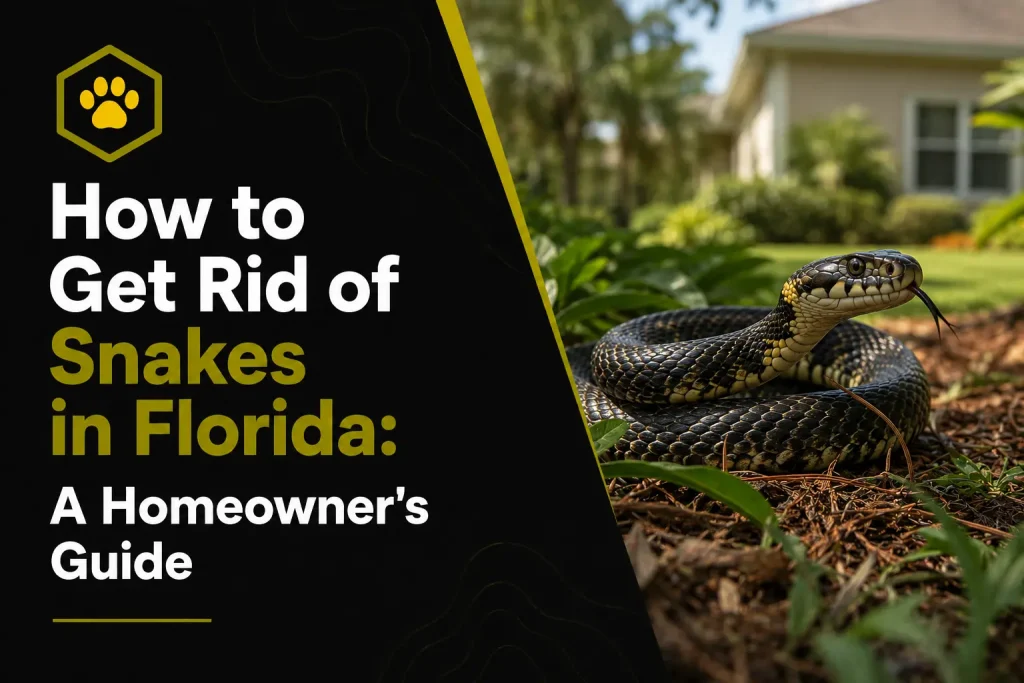
Florida is home to more than 50 native snake species, and a warm, humid climate that keeps almost all of them active for most of the year. In Central Florida, snake encounters peak from March through October, but homeowners can find snakes in garages, pool cages, and attics in any month with above-average temperatures. The good news is snakes don’t pick homes at random. They follow three things — food, water, and shelter — and once you understand what is pulling them in, you can use a layered approach to push them out and keep them out for good. This guide walks through the conditions that attract snakes to Florida properties, the early warning signs of activity, and ten detailed steps to get rid of snakes the right way.
Areas Around Homes That Attract Snakes
Snakes look for cover, prey, and warmth in roughly that order. The features below give them all three, which is why they show up around so many Florida properties — sometimes in yards that the homeowner thought were perfectly maintained.
- Tall grass, overgrown beds, and untrimmed hedges touching the foundation
- Wood piles, brush piles, and yard debris stacked near the house
- Mulch beds, leaf litter, and rock landscaping that hold heat after sunset
- Bird feeders, pet food bowls, and chicken coops that draw rodents
- Standing water — birdbaths, leaky AC condensate lines, irrigation puddles
- Garages and sheds with worn weather stripping or gaps under the door
- Crawl spaces, foundation cracks, and unsealed utility penetrations
- Detached pool equipment closets, torn lanai screens, and open soffit vents
- Compost piles, drainage culverts, and unmaintained ponds at the property edge
Signs You May Have Snakes Around Your Property
Snakes are quiet and good at hiding, but they leave behind clues. Watching for these signs in the yard, garage, and attic usually catches a problem before anyone actually sees a live snake.
- Shed snake skins in garages, sheds, or tucked along the foundation
- Long, slithering tracks in dust, dirt, or fine mulch after a calm night
- Snake droppings — dark and tubular with a chalky white urate cap
- A sudden drop in rodent activity after a steady problem
- Pets fixating on a corner, gap, or specific spot in the garage or yard
- A musty, cucumber-like smell in attics, crawl spaces, or under decks
- Lizards, frogs, or small birds disappearing from your yard
- Live sightings, especially in early morning, dusk, or right after summer rain
How to Get Rid of Snakes in Florida
Snake control in Florida is layered: habitat changes first, exclusion second, repellents third, and direct removal only when needed. The ten steps below work in that order. Skip the early ones and the later ones won’t hold for long.
1. Identify the Snake Species Before You Do Anything
Florida has only six venomous snake species — the eastern diamondback rattlesnake, pygmy rattlesnake, timber rattlesnake, cottonmouth, copperhead, and eastern coral snake. Every other snake you find around a Central Florida home is non-venomous, and many are protected. Yellow rat snakes, black racers, ringneck snakes, and garter snakes are the species most often misidentified as venomous. Before you reach for a shovel or a repellent, take a phone photo from a safe distance and compare it to the Florida Fish and Wildlife Conservation Commission’s online identification guide. Killing a protected non-venomous snake can earn fines, and the rat snake you killed was very likely the reason you weren’t seeing rats in the attic.
2. Cut the Grass and Tighten Up Your Landscaping
Snakes avoid open, exposed lawns because hawks and other predators have an easy line of sight. The single fastest yard-level change is to mow weekly during the growing season and keep grass under four inches. Trim every shrub, hedge, ornamental, and bromeliad at least twelve inches back from the foundation, AC pad, lanai screen, and walkways. The most attractive corner on any Florida property is the spot where dense landscaping meets the siding — fix those areas first. After every mow, walk the perimeter and remove clippings, leaves, and palm fronds piled against the wall.
3. Remove Wood Piles, Brush, and Yard Debris
Stacked firewood, leaf piles, and brush piles are five-star snake shelters. They hold heat, hide the snake from predators, and almost always contain the insects, lizards, and small mammals snakes feed on. Move firewood at least twenty feet from the house and stack it on a raised metal rack so air flows underneath. Take brush and yard debris to the curb on collection day rather than stockpiling it in a back corner. If you compost, place the bin well away from the house and turn it regularly — cold, undisturbed compost piles are excellent snake hideouts.
Also Read: Identify Snake Scat / Droppings ID
4. Solve the Rodent Problem on Your Property
This is the single most important step for long-term snake control in Florida, and the one most homeowners skip. Snakes follow food. The yellow rat snakes and black racers in Central Florida garages and attics are there because rats, mice, frogs, or lizards live there. Eliminate the food source and most snakes leave on their own within a few weeks. Set snap traps and tamper-resistant bait stations along travel routes, clean up bird seed spillage, secure pet food in metal containers, and lock down trash bins. A property with an active rodent problem will keep attracting snakes no matter how much repellent goes down.
5. Seal Every Gap Larger Than ¼ Inch
Snakes squeeze through openings far smaller than they look. The working rule is that any gap larger than a quarter inch — roughly the thickness of a pencil — is a potential entry point. Inspect garage door bottoms, foundation cracks, weep holes, dryer vents, AC line set penetrations, the gap under pool screen tracks, and the seam where the soffit meets the wall. Pack steel wool into small holes and seal with polyurethane foam or exterior caulk; cover larger openings with ¼-inch galvanized hardware cloth. Garage door seals are the number-one entry point in Florida and need to be replaced every two to three years in this climate.
6. Repair Lanai Screens, Soffits, and Shed Doors
Snakes don’t need to climb a wall to enter a Florida home. Torn pool screens, sagging soffits, gable vents missing their screening, and shed doors with worn weather stripping all give snakes direct access. Walk the property in daylight and patch every visible tear with screen patch tape or a replacement panel. Tighten loose soffit panels and replace any weather stripping that has hardened in the sun. Any vent screen larger than a quarter inch should be replaced with hardware cloth or fine metal mesh — the standard plastic vent screen most builders install is not snake-proof.
Helpful for you: How to Identify Snake Tracks
7. Install Snake-Proof Mesh Around Vulnerable Zones
Some areas of a Florida property are too important or too exposed for general exclusion alone. Pool equipment closets, chicken coops, rabbit hutches, compost bins, and crawl space vents all benefit from a tight ring of ¼-inch hardware cloth dug six inches into the soil and rising eighteen to twenty-four inches above grade. The buried portion stops snakes from sliding underneath; the above-grade portion blocks them from climbing through. This is also the right barrier for chicken coops in counties with cottonmouth or rattlesnake activity, where a single snake in the coop can wipe out a season’s worth of eggs.
8. Apply a Targeted Snake Repellent Around Shelter Zones
Repellents are a supplement, not a fix. They work best as a narrow band around foundations, sheds, garages, and pool equipment closets — not blanket-applied across the whole yard. Granular sulfur and clove-cinnamon essential oil formulas are the two most effective commercial options for Florida homes (see the comparison table below). Reapply after every heavy rain, and remember that the Florida rainy season will wash through a granular product much faster than the label predicts. Skip mothballs entirely — they are ineffective against snakes, banned for outdoor use in many cases, and toxic to pets and children.
Must Read: How Does Snakes Sound
9. Use Glue Boards or Traps Inside Garages and Sheds
If a snake is actually seen inside a garage, shed, or pool equipment closet, a snake-rated glue board placed along the wall (covered by a low-lying box for shade) or a minnow trap baited with a small live mouse can capture non-venomous snakes for relocation. Always check the trap daily — leaving a snake stuck for days is illegal in most jurisdictions and unsafe for the next person who walks in. To release a trapped non-venomous snake, gently apply vegetable oil to dissolve the glue and let it crawl free outdoors, well away from the house. For any venomous species or a snake you cannot positively identify, do not approach — call a licensed wildlife removal service.
10. Call a Licensed Snake Removal Service for Repeats or Venomous Species
If you are finding snakes repeatedly, seeing fresh shed skins every few weeks, or have spotted a venomous species near the home, stop the DIY work and bring in a licensed professional. Florida law restricts the handling of venomous and certain protected snakes, and many homeowner’s insurance policies require professional documentation if a snake bite occurs on the property. A Central Florida wildlife trapper identifies the species, locates the shelter spot (usually in an attic corner, soffit cavity, or under a slab), addresses the underlying attractant — almost always rodents — and seals the entry points a homeowner is likely to miss. One inspection usually replaces months of failed DIY attempts.
Also Read: Summer Wildlife Activity in Central Florida
Best Snake Repellents for Florida Homes
Repellents work best around foundations, sheds, and garage perimeters once habitat and rodent issues are addressed. The table below compares the products that have actual field performance in Florida conditions.
| Repellent Type | Active Ingredient | Best For | Coverage | Reapplication | Notes |
|---|---|---|---|---|---|
| Granular sulfur blends | Sulfur, naphthalene | Yard perimeters, foundations, shed bases | ~3,000 sq ft per 4 lb bag | Every 2–3 months | Florida rain washes it out faster than the label predicts; reapply after every heavy storm |
| Essential oil sprays | Clove (eugenol), cinnamon oil | Garages, sheds, lanais, pool equipment closets | Up to 1,000 sq ft per bottle | Every 30 days | Pet- and child-safer; smell fades quickly so consistent reapplication is required |
| Predator urine granules | Fox or coyote urine | Open yards, garden edges, chicken coop perimeters | ~500 sq ft per bottle | Every 2–3 weeks | Strong odor that drives away small mammals as well; reapply after rain |
| Ultrasonic stakes | Vibration / sound pulses | Lawns and gardens with light infestations | ~7,000 sq ft per stake | One-time install; replace batteries seasonally | Inconsistent results in independent testing — only use as a supplement to habitat changes |
| Habitat modification | None — physical changes only | The entire property | Whole property | Maintain year-round | The most reliable long-term deterrent; almost every successful snake-free property relies on it |
Mothballs are not a snake repellent. They are toxic to pets and children, banned for outdoor use in many cases, and ineffective against Florida snake species — skip them entirely.
How to Prevent Snakes From Coming Back
Once snakes are gone, prevention is mostly about removing the conditions that brought them in. A few habits will keep a Florida property snake-resistant year-round.
- Keep the lawn cut short and shrubs trimmed back twelve inches from the siding
- Store firewood and lumber on raised racks at least twenty feet from the house
- Install tight-fitting door sweeps on garage, shed, and outbuilding doors
- Maintain consistent rodent control — bait stations, snap traps, and exclusion
- Empty standing water from saucers, buckets, and clogged gutters weekly
- Inspect attic vents, soffits, and weep holes every spring before activity picks up
- Clean up bird seed spillage that attracts the rats and mice snakes hunt
- Schedule a yearly perimeter inspection of the foundation and exterior walls
- Trim trees that overhang the roof — they create a highway for both snakes and the rats that draw them
How CFL Trappers Can Help You
Central Florida Trapper provides licensed snake inspection, humane removal, and full-property exclusion across the Central Florida. Our team identifies the species on sight, locates shelter spots in attics, garages, crawl spaces, and pool equipment closets, and addresses the underlying reasons snakes are showing up — which usually means dealing with the rodent population first. We also handle the exclusion work that homeowners typically miss: soffit gaps, garage door sweeps, weep holes, foundation cracks, and torn vent screens. After the work is done, we schedule follow-up inspections through the active season to confirm the problem hasn’t reopened. If you are finding snake skins, droppings, or live snakes anywhere on the property, contact us for a thorough assessment.
Conclusion
Snakes are part of life in Florida, but they do not have to be part of your home. Most cases come down to the same fix: shorten the grass, clean up the debris, seal the gaps, and break the rodent cycle that feeds the snake. Layer in a targeted repellent, stay on top of yearly maintenance, and call in a licensed pro when a sighting is venomous, repeated, or indoors. Do that consistently and your property stops looking like an easy place for a snake to settle in.
FAQs
What time of year are snakes most active in Florida?
Snakes are active year-round in Central Florida but peak from March through October. Activity climbs sharply during the summer rainy season and after warm-weather cold fronts that push them toward shelter inside structures.
Are snake repellents safe for pets and children?
Sulfur and naphthalene blends should be applied only in areas where pets and kids cannot reach them. Essential oil sprays and habitat modification are far safer choices for households with animals or small children.
Do mothballs really keep snakes away?
No. Mothballs are not an approved or effective snake repellent. They are also toxic to pets and people and banned for outdoor use in many cases. Use a product specifically labeled for snakes — or rely on habitat changes, which work better than any chemical option.
What should I do if I find a snake inside my Florida home?
Keep pets and people out of the room, close the door if possible, and do not try to handle or kill the snake. Call a licensed snake removal service — especially if you cannot positively identify the species. Most non-venomous snakes will leave on their own through the same opening they entered if given a clear path.
Are all Florida snakes venomous?
No. Florida has six venomous species — the eastern diamondback rattlesnake, pygmy rattlesnake, timber rattlesnake, cottonmouth, copperhead, and eastern coral snake. The vast majority of snakes found around Central Florida homes are non-venomous rat snakes, racers, and water snakes that actually benefit the property by controlling rodents.
How much does professional snake removal cost in Central Florida?
Costs vary by species, accessibility, and whether exclusion work is included. A standard inspection and single-snake removal is typically a fraction of what homeowners spend on repeated DIY attempts that don’t address the underlying cause.