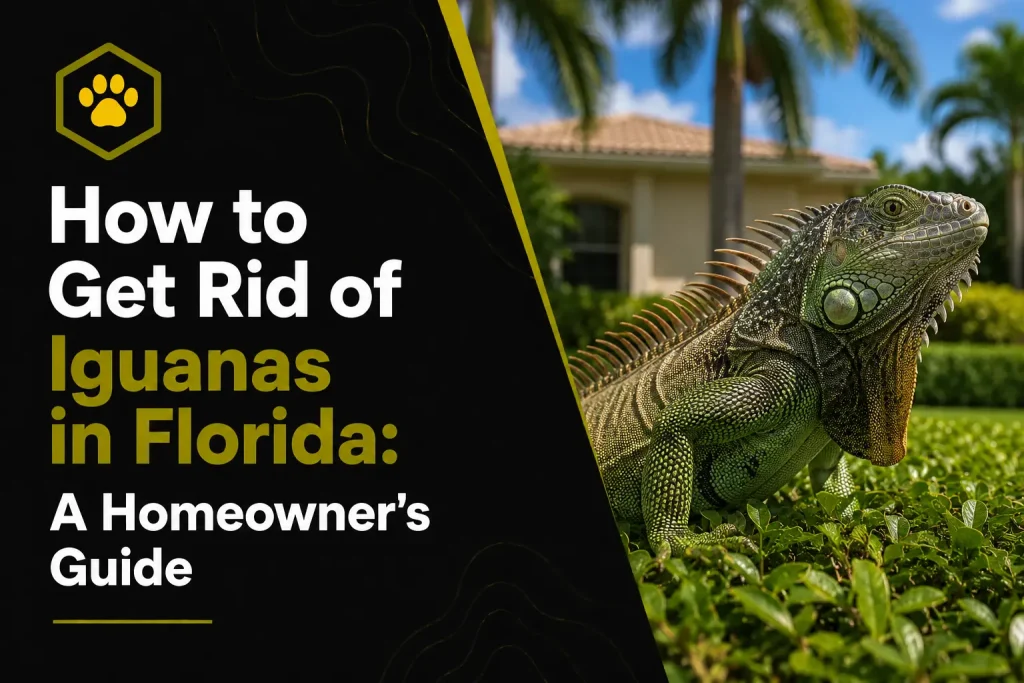
Green iguanas have spread from South Florida deep into Central Florida, and homeowners are now finding them sunning on seawalls, digging burrows under pool decks, and stripping hibiscus plants overnight. They are non-native, classified as an invasive species, and reproduce fast — a single female can lay up to seventy eggs a year. Left alone, a small iguana problem turns into a property-damage problem within one to two seasons: collapsed seawalls, undermined pool decks, ruined ornamental gardens, and waste fouling pool decks. This guide walks through exactly what attracts iguanas, how to tell when they have settled in, and ten detailed steps for getting rid of iguanas in Florida using methods that actually work.
Areas Around Homes That Attract Iguanas
Iguanas need three things to set up on a property: warm basking spots, soft soil for burrowing, and easy plant food. A surprising number of Florida yards give them all three within a single lot.
- Seawalls, canal banks, and waterfront retaining walls used as basking ledges
- Pool decks, paver patios, and concrete pads that hold daytime heat into the evening
- Ornamental gardens with hibiscus, bougainvillea, orchids, and bromeliads
- Citrus, mango, papaya, and other tropical fruit trees
- Loose, sandy soil along foundations, sheds, and seawalls — ideal for burrows
- Dense shrubs, vines, and palm fronds that provide overhead cover
- Bird feeders and dropped pet food that bring extra browsers around
- Unsecured compost piles, open trash bins, and outdoor grills with food residue
- Pool screens and stucco walls with horizontal ledges they can climb
Signs You May Have Iguanas Around Your Property
Iguanas are big, but they hide better than people expect. These signs usually appear well before homeowners actually see one in the yard.
- Large droppings — dog-pile size, dark with a chalky white urate cap
- Burrow openings four to six inches wide along seawalls, foundations, or pool decks
- Stripped leaves and flowers, especially hibiscus, bougainvillea, and orchids
- Bite marks on soft fruit like mangoes, papayas, and figs
- Sinkhole-like depressions in lawns and garden beds from collapsed burrows
- Long claw tracks on pool screens, soffits, or stucco walls
- Iguanas basking on seawalls, fences, roofs, or tree branches in the morning
- Floating debris in pools after iguanas fell in during a cold snap
Helpful for you: Iguana Scat/Droppings Identification Guide
How to Get Rid of Iguanas in Florida
Iguana control in Florida is a layered process — habitat changes, exclusion, deterrents, and direct removal working together. No single product or trick removes them on its own. The ten steps below run in the order they actually work in the field.
1. Know the Law Before You Act
Green iguanas are listed as an invasive species in Florida, which means they can be humanely killed on your own property without a special permit. That sounds simple but comes with caveats: animal cruelty laws still apply, firearms are restricted in residential areas under local ordinances, and certain methods (drowning, freezing, blunt force) are explicitly prohibited. Most homeowners get better results — and avoid any legal gray area — by relying on live trapping and licensed removal. Always confirm the species before acting; protected native lizards can look similar to juveniles at a glance.
2. Remove the Plants Iguanas Target
Hibiscus, bougainvillea, orchids, bromeliads, and most flowering tropicals are an iguana buffet. If a property has been hit repeatedly, the most effective long-term move is to replace high-target plants in the affected zone with iguana-resistant options like crotons, oleander, citrus, pentas, lantana, milkweed, and most strongly aromatic herbs. Plants iguanas dislike are typically bitter, toxic, or have rough textured leaves. You don’t have to clear the yard — just stop offering the favorite foods at the most visible spots.
3. Pick Fruit Early and Clear Fallen Fruit Daily
Mango, papaya, fig, banana, and avocado trees can pull iguanas in from blocks away. Pick fruit a day or two before it would naturally ripen on the tree, and clear any fallen fruit every morning during the bearing season. Composting fallen fruit directly under the tree is not a fix — it concentrates the smell and the calories in one spot. If a tree is producing more than the household can use, donate the excess or net the crown to keep iguanas (and roof rats) out of it entirely.
Also Read: What Do Iguana Tracks Look Like?
4. Fill in Burrows and Seal Them So They Cannot Reopen
Iguana burrows undermine seawalls, pool decks, and foundations — the damage is structural, not cosmetic. Before sealing, confirm the burrow is empty by checking for fresh tracks at the entrance after watering it down (dry tracks the next morning means no activity inside). Fill the burrow with rocks and packed soil or concrete patch, then seal the opening with ½-inch hardware cloth pinned by half-inch rebar so the iguana cannot reopen it. Larger burrow networks along seawalls almost always need professional inspection — the visible hole is rarely the only one.
5. Wrap Fruit Tree Trunks with Sheet Metal
A smooth metal collar twenty-four inches tall, installed two to four feet up the trunk and sealed at the seam, removes the grip iguanas use to climb. Use aluminum or galvanized steel; do not use mesh, which gives them something to claw onto. The collar should be loose enough to allow trunk growth but tight enough that an iguana cannot squeeze behind it. This single fix can save a mango or citrus crop that has been getting hit annually.
6. Install Iguana-Proof Fencing Where It Matters
Solid fences at least four feet tall, with no horizontal foot-holds on the iguana’s side, keep most adult iguanas out of small yards and garden beds. Chain-link is not iguana-proof — they climb it easily. Solid PVC, smooth metal, or stucco-finished walls work much better. For waterfront properties, the fence should run all the way to the seawall edge or be paired with a buried ¼-inch hardware cloth barrier extending twelve inches underground.
Must Read: What Iguanas Sound Like
7. Use Motion-Activated Sprinklers in Active Zones
Motion-activated sprinklers are one of the very few deterrents iguanas consistently react to. A sudden blast of water in the morning, when iguanas come out to bask, sends them looking for a quieter property. Place units around pool decks, garden beds, and any waterfront basking ledge. Coverage is roughly forty feet per unit, so larger properties may need two or three. They work at night as well, which makes them useful for the rest of the wildlife problem most Florida homes deal with too.
8. Apply Repellent Sprays to Ornamental and Edible Plants
Garlic-based sprays, neem oil, and capsaicin pepper formulas reduce iguana feeding on individual plants when applied weekly. They work by combining strong odor with bitter or burning taste, so the iguana learns the plant is not worth visiting. Reapply after every rain and immediately after watering the plant. None of these is a complete fix on its own — they are best used to protect specific high-value plants in the broader strategy.
9. Set Live Cage Traps Near Burrows and Basking Spots
Live cage traps baited with ripe mango, papaya, melon, or banana are the most effective DIY removal method on a single-property scale. Place traps at burrow entrances, along seawalls, or under known basking spots, and prop them open for a few days with bait inside so iguanas get comfortable entering. Once they are feeding regularly, set the trap. Check daily — leaving an iguana in a trap in Florida heat is both illegal and lethal to the animal. Captured iguanas must be euthanized humanely under Florida law; they cannot legally be released elsewhere.
10. Call a Licensed Nuisance Wildlife Trapper for Ongoing Infestations
For HOA properties, large lots, repeated infestations, and seawall or pool deck damage, DIY rarely catches up with the population. A licensed Central Florida Wildlife trapper can map burrow systems, run multiple traps at once, handle humane removal in volume, and install the hardware cloth and tree wraps that keep the next generation out. Iguana removal is one of the few wildlife problems where professional service usually costs less than another season of replaced landscaping. Many trappers also coordinate neighborhood-scale removals where multiple properties share the same population.
Best Iguana Deterrents for Florida Homes
Deterrents work best when they back up habitat changes. The table below matches the right deterrent to the situation.
| Deterrent | How It Works | Best For | Coverage | Reapplication | Notes |
|---|---|---|---|---|---|
| Motion-activated sprinklers | Sudden water blast startles iguanas | Lawns, garden beds, pool decks | ~40 ft radius per unit | One-time install | Most reliable single deterrent; works day and night |
| Garlic and neem spray | Strong odor and bitter taste on leaves | Ornamental gardens, edible plants | Up to 1,000 sq ft per gallon | Weekly, after rain | Safe for kids, pets, and pollinators |
| Capsaicin (pepper) granules | Burning sensation on contact and ingestion | Garden borders, mulch beds | ~500 sq ft per pound | Every 2–3 weeks | Avoid in pet play areas |
| Sheet metal tree wraps | Removes climbing grip | Fruit trees and palms | Per tree | One-time install | Smooth aluminum, 24 inches tall, sealed seams |
| Hardware cloth barriers | Physical block at burrows and gaps | Seawalls, sheds, pool equipment | Per linear foot | Inspect twice a year | Bury 12 inches deep to stop digging |
| Live cage traps | Captures the iguana for removal | Burrow entrances, basking spots | 1 trap per active area | Check daily | Bait with mango, papaya, or melon |
How to Prevent Iguanas From Coming Back
Iguanas return to properties that meet their needs. Make the yard less attractive and the problem stops repeating.
- Replace high-target plants with iguana-resistant alternatives
- Keep tree wraps and hardware cloth in place year-round
- Inspect seawalls, pool decks, and foundations seasonally for fresh burrows
- Pick ripe fruit daily during mango and papaya season
- Clear dropped fruit, palm fronds, and yard debris weekly
- Trim back overhanging branches that bridge fences and roofs
- Keep compost in sealed bins and trash lids secured
- Stay in touch with neighbors — iguana control works best when the whole block participates
How CFL Trappers Can Help You
Central Florida Trapper provides professional iguana removal and control services in Central Florida, handling humane trapping, burrow exclusion, and full-property inspections for residential and commercial properties. Our team locates active burrows along seawalls, foundations, and pool decks, removes the animals on site, and installs hardware cloth and tree wraps so the same iguanas (and their offspring) cannot return. We also coordinate larger neighborhood and HOA removals, where multiple properties share the same population — and where a coordinated effort dramatically cuts the long-term cost. If iguanas are tearing up your landscaping, undermining your seawall, or basking on your roof, contact us for a property assessment.
Conclusion
Iguanas are not going away from Florida — they are spreading. The properties that stay clear are the ones that make themselves boring to iguanas: no easy food, no easy burrows, no easy basking spots, and no horizontal climbing surfaces. Remove the attractants, install a few key barriers, and use traps or a licensed pro when needed. Stay consistent and a yard that lost its hibiscus garden last season can be iguana-free by the next.
FAQs
Is it legal to kill iguanas in Florida?
Yes, on your own property. Green iguanas are listed as an invasive species and can be humanely killed without a permit. Cruelty laws still apply, and shooting them in residential areas may be restricted by local ordinances.
What plants do iguanas hate?
Iguanas tend to avoid milkweed, crotons, oleander, citrus, pentas, lantana, and most strongly aromatic herbs. Swapping high-target plants for these reduces feeding significantly.
Why do iguanas fall out of trees in winter?
Iguanas are cold-blooded. When Florida temperatures drop into the 40s, their muscles stop working and they fall out of trees. They look dead but often warm back up — handle with care or leave them for animal control.
How deep are iguana burrows?
Iguana burrows can extend three to six feet deep and run several feet horizontally. Burrows under seawalls and pool decks can cause structural collapse over time, which is why they should be filled and sealed quickly.
Will mothballs or ammonia get rid of iguanas?
No. Both are unreliable and unsafe outdoors. Motion-activated sprinklers, capsaicin granules, and habitat modification are far more effective and legal.
How much does iguana removal cost in Central Florida?
Pricing depends on property size, the number of active burrows, and whether seawall or pool deck exclusion is needed. A standard inspection plus initial trapping typically runs less than the cost of replacing damaged landscaping or repairing a collapsed seawall.