If you live in Central Florida and have spotted strange, hand-like prints around your pool, garden, or yard, there is a strong chance a raccoon has been visiting overnight. Raccoon tracks are among the most distinctive in North American wildlife — they look surprisingly like a tiny human handprint and are easy to identify once you know what to look for. This guide explains exactly how to recognize raccoon tracks, where they tend to appear in Central Florida, how to tell them apart from similar species, and what their presence on your property usually means.
What Do Raccoon Tracks Look Like?
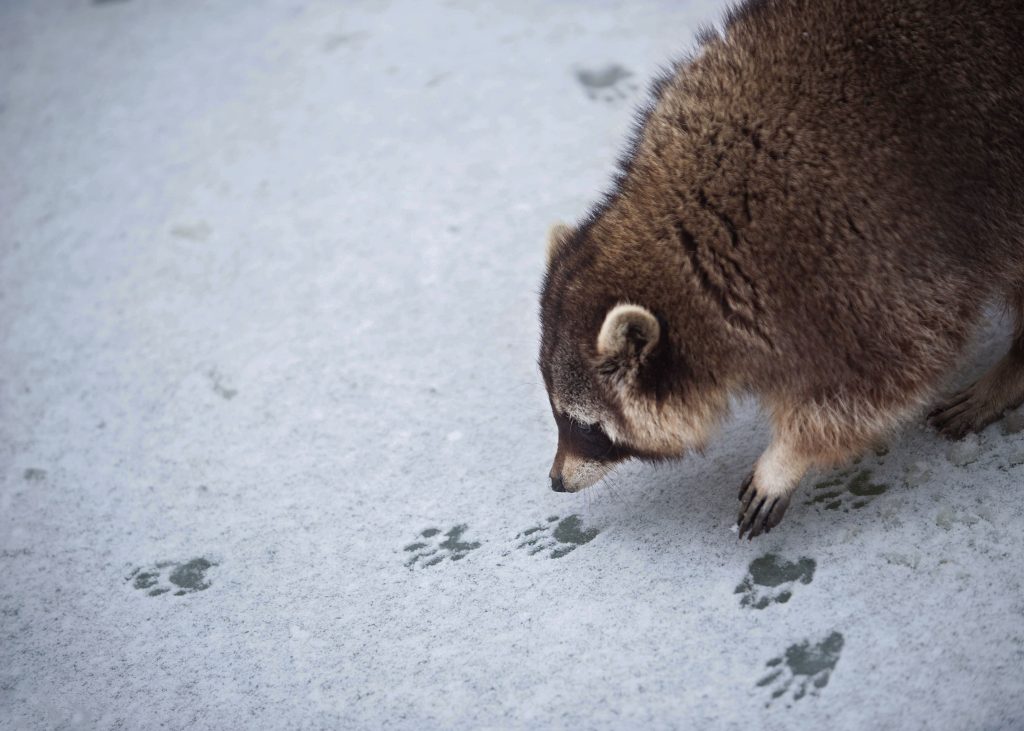
Raccoons are plantigrade walkers, which means they place their entire foot on the ground much like humans and bears do. The result is a long, flat-footed track with five clearly defined toes on both the front and back feet — a feature shared by very few other animals in Central Florida.
Front Paw Prints
The front print resembles a small human hand. It typically measures 2 to 3 inches long and 2 to 2.5 inches wide. You will see five long, slender toes radiating from a roughly square palm pad, with the toes spread apart rather than bunched together. Claw marks may or may not be visible depending on the surface, but they are usually small and close to the toe tips.
Hind Paw Prints
The hind print is longer — usually 3 to 4 inches in length — and looks more like a miniature bare human foot, with a distinctly elongated heel pad behind the five toes. The hind print is the most diagnostic feature of raccoon tracks; nothing else in Central Florida leaves a print that combines a long heel with five fully splayed toes.
Stride and Pattern
Raccoons leave a recognizable side-by-side track pattern. As they walk, the front paw of one side and the hind paw of the opposite side land close together, producing a paired track that often looks like a left front next to a right hind. Spacing between pairs is usually 6 to 14 inches.
Where to Look for Raccoon Tracks in Central Florida
Central Florida’s sandy soil, frequent rain, and abundant water features mean raccoon tracks are easier to find here than in many parts of the country. Common locations include:
- The muddy banks of retention ponds, lakes, and drainage ditches
- Sand or wet grass around pool decks and lanais
- Dust on attic insulation and on flat roofs after rain
- Garden beds, freshly turned mulch, and vegetable plots
- The dust on car hoods or pool covers in the morning
- Beach sand near the Atlantic and Gulf coasts within an hour of Orlando
Because raccoons are nocturnal, the best time to find fresh tracks is at first light, before heat, sprinklers, and foot traffic erase them.
How to Tell Raccoon Tracks From Other Animals
Several Central Florida species leave prints that get confused with raccoon tracks. Here is how to keep them straight.
Raccoon vs. Opossum Tracks
Opossums also have five toes, but their hind print is unmistakable: the inner “thumb” sticks out at an opposable angle, more like a small primate hand than a human foot. Raccoon hind prints have all five toes pointing roughly forward.
Raccoon vs. Domestic Dog or Cat Tracks
Dogs and cats have only four toes per foot and a single rounded heel pad. Their prints are roughly oval, never hand-shaped, and dogs almost always show prominent claw marks. If a print has five toes, it is not a dog or cat.
Raccoon vs. Otter or Mink Tracks
River otters and mink also leave five-toed prints near water, but their toes are connected by webbing that often shows in mud. Raccoon toes are clearly separated and the print as a whole is more elongated and “human-looking.”
Raccoon vs. Armadillo Tracks
Armadillos have very different prints — three or four pointed, claw-heavy toes, often dragging — and lack the splayed, hand-like quality of raccoon prints. Confusion is rare once you see them side by side.
What Raccoon Tracks Tell You About Activity
A single set of tracks crossing your yard usually means a raccoon passed through on its nightly route. Repeated tracks along the same path, around your trash cans, or up to a soffit, vent, or palm tree are a much bigger signal — they indicate a resident raccoon that has built your property into its routine.
Tracks leading directly to a structural opening, such as a damaged roof vent, are particularly important. Raccoons are powerful climbers and will exploit any 4-inch gap in a soffit, fascia, or attic vent to nest. Female raccoons searching for a denning site in late winter and early spring are responsible for the majority of attic intrusions in Orlando, Winter Park, and surrounding areas.
What to Do When You Find Raccoon Tracks
If you discover raccoon tracks on your property, take a few simple steps before the situation escalates:
- Photograph the prints with something for scale, such as a coin or your hand, and note the date
- Check trash cans, pet food bowls, and attic vents for damage or droppings
- Inspect roofline, soffits, gable vents, and the dryer vent for tampering
- Move pet food and garbage indoors after sunset
- Trim tree limbs that overhang the roof to remove raccoon access ramps
When to Call a Central Florida Wildlife Trapper
Tracks plus any of the following — droppings, sounds in the attic, damaged vents, repeated trash raids — usually mean a raccoon has set up shop on your property. At that point, the safest, fastest, and legal route is to bring in a licensed Central Florida wildlife trapper. Florida Fish and Wildlife Conservation Commission rules tightly regulate raccoon trapping and relocation, and DIY attempts often lead to trapped young in your attic, structural damage, and contamination from droppings and urine. A professional inspection identifies the entry points, removes the animals humanely, and seals the structure so the next raccoon that walks across your yard simply keeps walking.
If raccoon tracks have been showing up around your home anywhere in Central Florida, contact Central Florida Trapper for a thorough inspection and a removal plan tailored to your property.