Iguanas have moved from a South Florida curiosity to a Central Florida problem, and one of the easiest ways to confirm them on your property is by identifying their tracks. Green iguanas leave large, distinctive prints with prominent claw marks and a steady tail drag that almost no other animal in Florida produces. Whether you have noticed strange tracks across your pool deck, seawall, dock, or sandy yard, this guide explains exactly what iguana tracks look like, where they appear in Central Florida, and what they reveal about the iguana activity on your property.
What Do Iguana Tracks Look Like?
Green iguanas have five clawed toes on each foot and a long heavy tail that drags whenever they walk on level ground. The combination of five clawed toes plus a continuous tail drag is the diagnostic signature.
Front Paw Prints
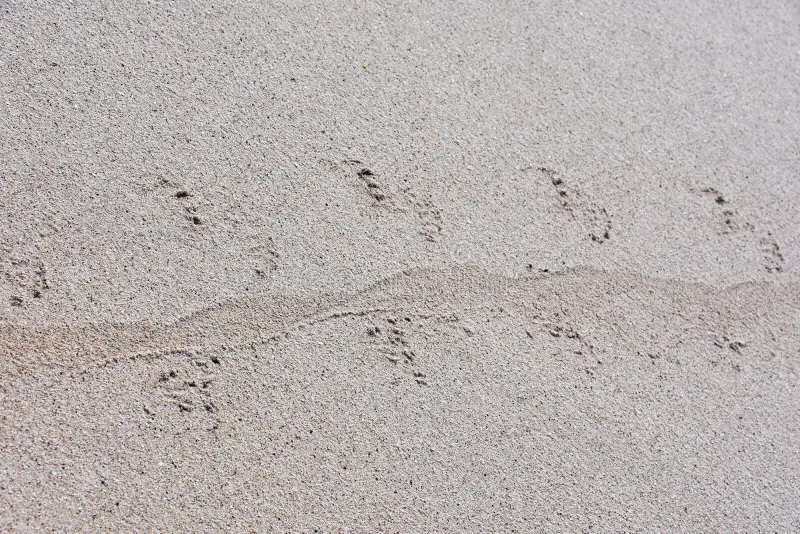
Front prints have five long, slender toes radiating outward, each tipped with a strong curved claw that often punches a sharp little mark into soft sand or mud. The toes are slightly splayed, and the palm pad is small. A full-grown adult leaves a front print 2 to 3 inches across; juveniles leave smaller, more delicate versions.
Hind Paw Prints
Hind prints are noticeably longer — 3 to 5 inches long in adults — with the central toes much longer than the side toes. The fourth toe is the longest, giving the hind print an asymmetric, almost dinosaur-like appearance. Claw marks are prominent at the toe tips.
Tail Drag
The most distinctive feature of an iguana trail is the continuous tail drag down the middle. The drag mark is wide, often 1 to 2 inches across for an adult iguana, and may be slightly wavy as the tail sways while the animal walks. This drag mark is heavier and more continuous than the inconsistent drag left by an opossum.
Stride and Pattern
Iguanas walk with a side-to-side waddle, similar to a small alligator. The front and hind paws on the same side move together, with stride between paired prints typically 6 to 14 inches in adults. The result is a track pattern with paw prints on each side and a clear central tail drag running between them.
Where to Find Iguana Tracks in Central Florida
- Sandy seawall edges and beach access points along canals and lakes
- Mulched flower beds, especially around hibiscus and bougainvillea
- Pool decks and patios with light dust, especially after rain
- Dock pilings, boat lifts, and waterfront walkways
- Sand or dirt around AC pads, foundation lines, and slab corners
- Soft soil along retention ponds and drainage swales
- Roof surfaces with light dust where iguanas bask
Tracks are usually freshest in the early morning, after iguanas have moved from overnight shelters to their basking spots in the sun.
How to Tell Iguana Tracks From Other Animals
Iguana vs. Smaller Lizard Tracks
Anoles and other small lizards leave miniature versions of iguana tracks, with the same five-toed prints and tail drag. Size is the easiest differentiator: anything with a 3-inch front print or a 1-inch-wide tail drag is almost certainly an adult iguana.
Iguana vs. Alligator Tracks
Alligators also leave five-toed clawed prints with a heavy tail drag, but their feet are wider and shorter, the tail drag is much wider (3 to 6 inches), and stride between prints is longer because of their larger size. Alligator tracks also tend to lead directly to and from water. Iguana tracks meander across yards, decks, and seawalls.
Iguana vs. Armadillo Tracks
Armadillos also leave a tail drag, but their footprints show only two or three pronounced clawed toes rather than five, and the front prints are much smaller. Armadillos also dig small cone-shaped holes near their tracks, which iguanas do not.
Iguana vs. Bird Tracks
Birds have three or four toes and no tail drag (with very rare exceptions). Birds also hop or alternate steps, while iguanas waddle with paired prints. There is no confusion once you have seen both side by side.
What Iguana Tracks Tell You About Activity
Iguanas are creatures of habit — they almost always travel the same path between sheltering spots, basking locations, and food sources. Repeated tracks along the same route, especially between a seawall and a favorite plant, indicate a resident iguana. Multiple sets of tracks of different sizes suggest both adults and juveniles, which often points to a breeding female nearby.
Tracks leading directly to a burrow opening in soft soil at the base of a seawall, sidewalk, or foundation slab confirm an iguana den. Iguana burrows can be several feet long and cause progressive erosion damage to the structures they undermine — a major reason for prompt removal.
What to Do When You Find Iguana Tracks
- Photograph the tracks with a coin or hand for scale
- Trace the trail back to find the iguana’s shelter or burrow
- Inspect favorite plants — hibiscus, bougainvillea, croton, citrus — for chewing damage
- Check seawalls, foundations, and pool decks for burrow openings
- Remove or net favorite food plants until iguanas are removed
- Block burrow entrances only after confirming the iguana has emerged for the day
Why Iguana Damage Escalates Quickly
Female iguanas dig long nesting burrows in soft soil during breeding season (typically February through April in Florida), and a single female can lay 20 to 70 eggs in a single clutch. Tracks that lead to a burrow near a seawall or pool deck can quickly become a nesting site, undermining the structure as the burrow expands. Combined with their voracious appetite for ornamental plants and their tendency to defecate in swimming pools, iguanas can cause thousands of dollars of damage in a single year if left unchecked.
When to Call a Central Florida Iguana Removal Specialist
Repeated iguana tracks, visible iguanas, or burrow openings on your property all justify a professional inspection. Central Florida Trapper offers licensed iguana trapping, burrow exclusion, landscape protection, and sanitation across the Orlando metro area and surrounding waterfront communities. Removal is regulated under Florida invasive species rules, and a licensed professional ensures every step — from identification to humane removal to property restoration — is handled correctly.